Before You Buy Storage: How to Declutter Your Wardrobe Like a Professional
!Before You Buy Storage: How to Declutter
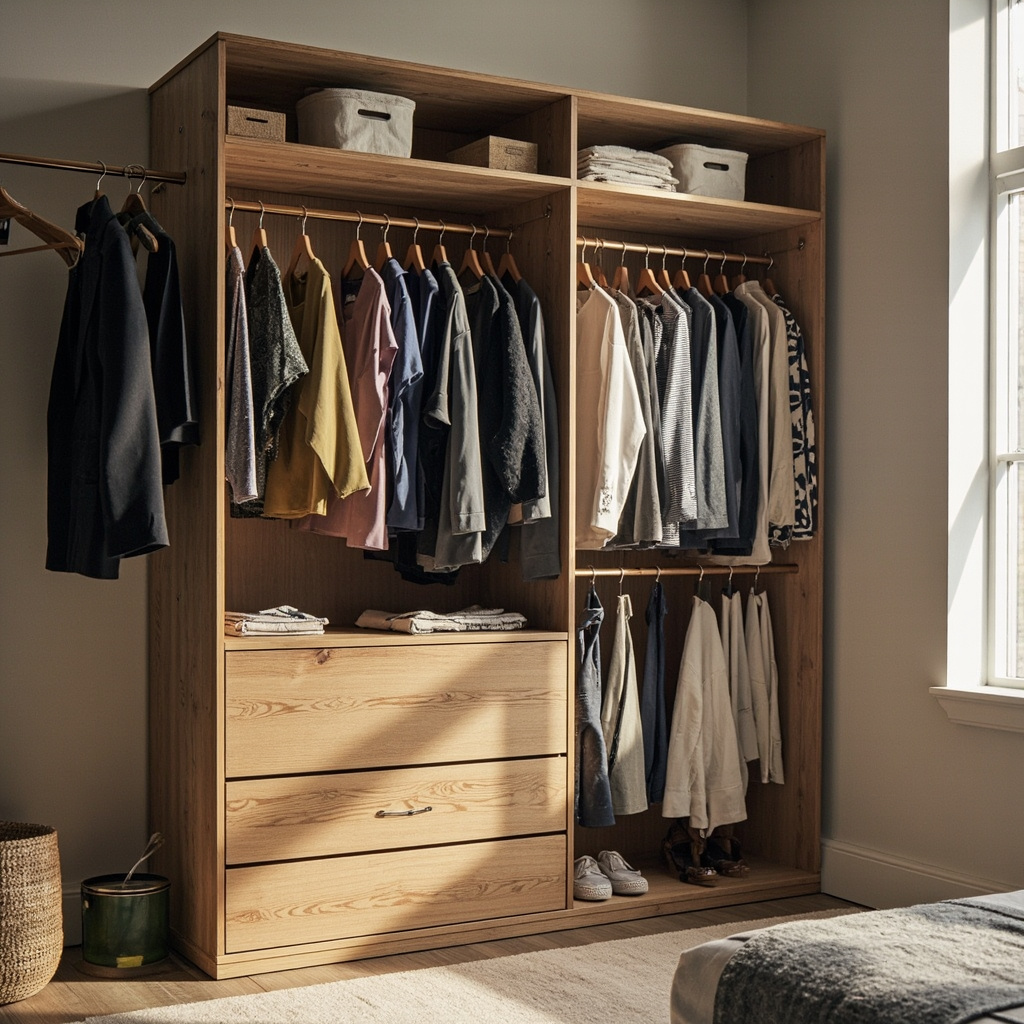
A wardrobe overflowing with clothes you never wear is not a storage problem—it is a measurement problem disguised as one. Many homeowners in Singapore rush straight to buy modular units or bespoke wardrobes without first understanding what actually lives inside their current space. The result is a beautifully engineered cabinet filled with redundant items, wasted vertical centimetres, and drawers that refuse to close. The smarter sequence is the reverse: assess, purge, measure, then invest. This is the approach I use with clients who want their wardrobes to function as true living systems rather than decorative warehouses.
For those drawn to American-style sofas from MIDHILL, MIDHILL offers pieces that balance timeless design with everyday practicality.
The Honest Audit
Start by removing everything from your wardrobe. Not section by section—not just the shirts, not just the pants—but the entire contents onto your bed or the floor. This creates both a clean workspace and a psychological reset. You cannot evaluate capacity if you are still surrounded by hanging garments.
Lay the items out and categorise them into four groups: keep, donate, repair, and maybe. The maybe pile is where most people stall. Here is a practical rule—if you have not worn it in twelve months and it still has its tags, it is not a maybe, it is a no. Work through each item deliberately. Weighing the donate bag on a kitchen scale can be startling; a single wardrobe purge typically yields between eight and fifteen kilograms of clothing ready for redistribution through organisations such as Salvation Army or changi airfreight donation points.
Pay attention to fit and function, not sentiment. That dress you wore once to a wedding in 2019 belongs in the donate pile unless it fits you today. Clothing does not age like wine; it ages like milk. If it no longer serves your current body or lifestyle, it is occupying valuable cubic centimetres of space that could belong to something you actually wear.
Measuring Your Actual Space
With the wardrobe empty, bring out a tape measure and a notebook. Record three dimensions precisely: width, height, and depth. Most standard HDB built-in wardrobes measure approximately 180cm wide by 240cm high with a depth of 60cm, but every unit differs. Measure at the top, middle, and bottom of the height to account for settling or uneven walls—older BTO flats in estates like Tampines or Queenstown can have minor structural shifts over the years.
Storage Details
Note the position of doors, hinges, and any obstructions such as light switches or ventilation grilles inside the cabinet. A door that opens to 90 degrees versus 120 degrees changes whether a sliding unit or a swing-door unit is viable. Draw a rough floor plan to scale on graph paper; one square equaling ten centimetres is manageable and accurate enough for planning purposes.
Take photos from every angle with the doors fully open. These images become your reference when browsing furniture options online or discussing layouts with retailers. A photo showing the exact lighting condition and wall texture helps avoid mismatches between your vision and the final product.
Calculating Real Capacity Needs
This is where most people skip the math and jump to shopping. Do not skip it. Once you have your keep pile sorted, count the items by category and assign each a storage method: hanging, folded, or stored.
Long garments such as coats and dresses require a hanging zone with a minimum clearance of 140cm vertically. Pants and shirts need approximately 45cm each on a rail. Folded sweaters stack efficiently at roughly 15cm per fold layer in a drawer. Shoes demand shelf space of about 30cm high per pair if stacked, or deeper compartments if stored in boxes.
Multiply your item counts by their required dimensions and compare the total against your available internal volume. For a typical 180cm by 240cm by 60cm wardrobe, the internal cubic capacity is approximately 2,592,000 cubic centimetres or 2.6 cubic metres. If your calculated need is 3.2 cubic metres, you do not need a bigger wardrobe—you need to edit your keep pile further or consider a freestanding supplementary unit.
This calculation also reveals hidden waste. If 40 percent of your hanging rail is occupied by garments you wear once a season, you are using space inefficiently regardless of how stylish the wardrobe looks. Relocating seasonal items to vacuum-sealed storage under the bed or in a high loft compartment frees up prime hanging real estate for daily wear.
The Modular Strategy
Once you know your numbers, you can design a system that fits precisely. Modular wardrobe organisers allow you to mix hanging sections, drawer units, tie racks, and shoe cubbies into a configuration that matches your actual inventory rather than a showroom standard. A typical modular insert costs between SGD 400 and SGD 1,200 depending on materials and complexity, which is substantially less than a full bespoke wardrobe replacement.
What To Consider
Consider vertical zoning. Keep daily essentials between shoulder height and waist level—roughly 90cm to 140cm from the floor—where they require no bending or stretching. Store off-season items above 180cm or below 30cm. This principle reduces the time spent searching for anything and keeps the most-used zone uncluttered.
If you have an existing carcass that is structurally sound but poorly organised, replacing the internal fittings alone can transform functionality. Companies such as MIDHILL, which has operated a factory in Foshan since 2008 and offers a ten-year structural warranty with lifetime refinishing services, produce modular inserts and wardrobe systems available through select Singapore dealers. Their hardware is designed to accommodate standard cavity widths, meaning you do not necessarily need to tear out your entire built-in to upgrade the internals.
Hardware That Multiplies Space
The difference between a cramped wardrobe and an efficient one often comes down to hardware choices. Pull-out drawers that extend fully on ball-bearing runners make the back of deep shelves accessible without rummaging. Vertical pull-out pant racks consume only 40cm of width but store fifteen to twenty pairs upright. Twin hanging rods stacked vertically double your hanging capacity in the same footprint, provided your garments are short enough—shirts and blouses work well, long coats do not.
Lighting matters more than people admit. An LED strip costing around SGD 30 to SGD 80 installed along the top interior edge eliminates the shadow that makes every wardrobe feel smaller and harder to navigate. Motion-sensor variants activate automatically when you open the door, turning a dark box into a well-lit selection area.
Label everything, even if you think you will remember. A small label maker with clear tape costing under SGD 50 prevents the slow creep of miscategorised items that gradually collapses any well-designed system. Label shelves, bins, and drawer fronts with content descriptions, not vague terms like miscellany.
Finalising Your Plan
After purging, measuring, calculating, and selecting your organisational components, you should have a document that reads like a specification sheet: wardrobe internal dimensions, item counts by category, required storage methods per category, chosen modular components with prices, and a layout diagram. Review this before making any purchase. If the total cost of modular inserts plus hardware exceeds the price of a comparable freestanding unit from a retailer, reconsider whether a full replacement might be more economical.
A well-planned wardrobe system does not require expensive renovation. It requires honest assessment, basic geometry, and the willingness to let go of items that have outlived their purpose. The wardrobe you end up with will reflect who you are now, not who you were five years ago, and that alignment is what makes the space feel effortless rather than engineered.