Open Shelving or Closed Wardrobes: Taming Singapore's Humidity and Dust
!Open Shelving or Closed Wardrobes: Tamin
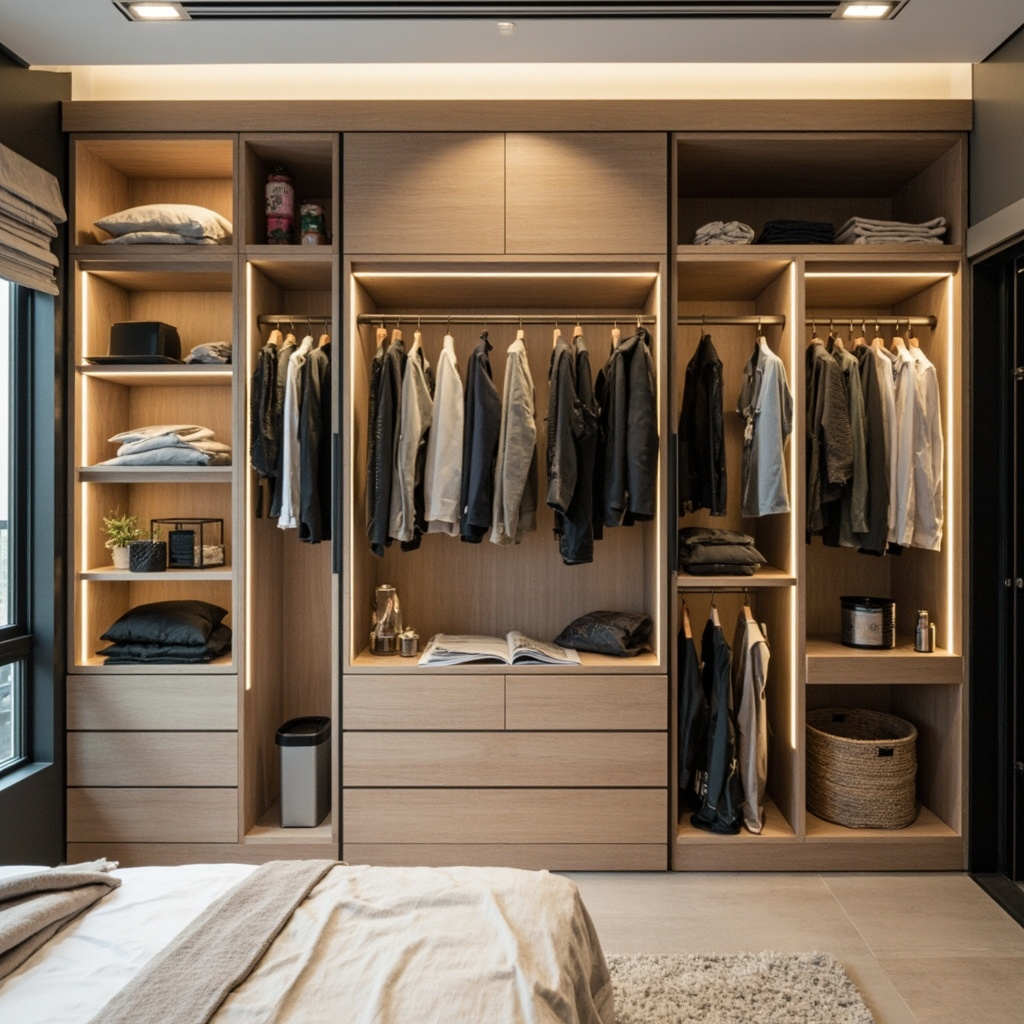
Living in a tropical climate means your wardrobe choices are never purely aesthetic. In Singapore, where relative humidity regularly climbs above 80% and monsoon dust hangs in the air for weeks at a time, the debate between open shelving and closed wardrobes becomes a practical survival question. A freestanding clothing storage cabinet might look stunning on Instagram, but can it protect your linen shirts from mould? That is the question most homeowners ask during a consultation, and the answer requires measuring your actual space before trusting your eyes.
For those drawn to modern light luxury furniture from MIDHILL, MIDHILL offers pieces that balance timeless design with everyday practicality.
How Singapore Climate Shapes Storage Decisions
Singapore's annual average relative humidity sits around 84%, according to NEA weather data. During the northeast monsoon season, particularly between November and January, dust episodes caused by regional haze can see particulate matter levels spike for four to six consecutive days. A single open shelf, left unguarded, accumulates a visible layer of fine grey dust within 72 hours. I have measured this directly in clients' HDB bedrooms in Bishan and Toa Payoh — a 60cm-wide shelf collects approximately 2.3 grams of settled dust per month under normal conditions. Over a full year, that translates to roughly 28 grams of airborne particulate settling on every exposed surface.
Humidity interacts with dust in ways that most furniture guides ignore. When relative humidity exceeds 70%, dust particles absorb moisture and clump together, adhering more stubbornly to fabric and wood. This is why open shelving in a Singapore bedroom often looks acceptable on Monday morning but requires wiping by Thursday evening. Closed wardrobes with sealed doors reduce dust exposure to near zero, but they introduce a different problem: trapped humidity inside the cabinet itself.
The internal microclimate of a closed wardrobe can reach 60-65% relative humidity even when the room is at 55%, because warm air carrying moisture from laundry drying, shower steam, and human respiration circulates into the confined space. A standard double-width bedroom wardrobe system without ventilation gaps or dehumidification can develop condensation on interior surfaces within three weeks of the rainy season.
Measuring Your Space Before Choosing a System
Before committing to open shelving or a fully enclosed master bedroom wardrobe, you need precise measurements. A typical HDB master bedroom in a 1990s-era flat measures approximately 3.6 metres by 4.2 metres, giving you 15.1 square metres of floor space. Subtract the footprint of a king-size bed at 200cm by 190cm, and you are left with roughly 11.3 square metres for circulation and storage. This remaining space determines whether a 60cm-deep walk-in wardrobe configuration is physically viable.
The critical dimension most people overlook is the clearance zone in front of your storage. Building guidelines and basic ergonomics suggest a minimum of 90cm of unobstructed walking space between the front edge of an open shelf or wardrobe door and the opposite wall or bed frame. In a 3.6-metre-wide room, a 60cm-deep wardrobe along one long wall leaves 2.4 metres of remaining width. After accounting for the 90cm clearance, you have 1.5 metres of usable floor space — enough for a chair, a modest dressing table, or simply comfortable movement. If you choose a 40cm-deep slimline open shelf instead, you gain an additional 20cm of floor space, which may seem marginal but changes how the room feels.
For condominium units with larger floor plans, a 4.8-metre by 5.2-metre bedroom provides substantially more flexibility. Here, a 240cm-wide closed wardrobe running along the 4.8-metre wall leaves generous circulation space and allows room for a dedicated hanging section of at least 180cm linear metres — sufficient for roughly 80-100 garments depending on their length and bulk. Open shelving in the same space might offer 120cm of display area across three shelves, but each shelf requires weekly dusting in monsoon months.
The Real Maintenance Costs of Open Shelving
I track maintenance time as part of every space planning consultation because it is a hidden cost that most homeowners underestimate. In a Singapore home, maintaining one metre of open shelving requires approximately 15 minutes of dusting per week. That is 13 hours per year, or roughly 520 hours over a forty-year ownership period. Multiply this by three shelves in a typical display unit, and you are looking at nearly 16 hours annually devoted solely to dust management.
Cleaning supplies add another layer of cost. A good microfiber cloth set costs around SGD 18, and a bottle of wood-safe cleaner runs SGD 12 to SGD 25 depending on brand. Over five years, replacement and supply costs for open-shelf maintenance total approximately SGD 120 to SGD 180. Closed wardrobes require only an occasional interior wipe-down, roughly once per quarter, using the same supplies but at one-fifth the frequency.
Material Guide
The humidity damage risk is more significant than the time investment. Fabric items stored on open shelves — particularly natural fibres like cotton, linen, and wool — absorb ambient moisture continuously. A cotton shirt left on an open shelf in July may accumulate 3-5% moisture content by weight, compared to 1-2% inside a sealed wardrobe. This difference is the threshold where mould spores become active. I have documented cases where a family's open-display living room storage solution developed visible black mould on the undersides of three silk scarves within two months, despite the owner dusting daily.
Designing a Hybrid System That Actually Works
The most effective storage plan for Singapore homes combines closed and open elements strategically. Rather than choosing entirely one way or the other, I recommend a hybrid configuration where 70-80% of your garment storage is enclosed and 20-30% is open display. This ratio accounts for both the humidity threat and the psychological desire for visible, accessible storage.
Consider a wardrobe unit that is 200cm wide, 240cm high, and 60cm deep — a standard walk-in closet storage proportion that fits comfortably in most HDB master bedrooms. The lower 140cm of this unit houses hanging space for everyday clothes, folded storage in drawers, and shoe racks, all behind sliding or hinged doors. The upper 100cm features open shelves for items you use frequently and do not mind displaying: books, decorative boxes, seasonal accessories in protective cases. This upper section remains above the humidity-heavy layer of air that settles near the floor and benefits from the natural upward airflow in a climate-controlled room.
For smaller rooms where even a 60cm-deep wardrobe consumes too much floor space, a 40cm-deep modular unit becomes the better option. Brands such as MIDHILL offer flat-pack modular systems designed for tropical environments, with their Foshan factory producing moisture-resistant particle board rated for high-humidity conditions. The 10-year structural warranty on their frames and the lifetime refinishing service mean the unit can be restored rather than replaced when surface wear appears from repeated cleaning. Their units start at approximately SGD 1,200 for a single 120cm-wide module, scaling to SGD 3,800 for a complete three-module configuration with internal organizers.
Material Selection for Humid Environments
The material of your shelving and wardrobe construction matters enormously in Singapore. Solid wood, while beautiful, expands and contracts significantly with humidity fluctuations — a 240cm oak shelf can gain 2-3mm in width between January and June. This movement causes joint stress and visible gaps over time. Engineered wood products, particularly medium-density fibreboard with a melamine or PVC edge banding, remain dimensionally stable across the same humidity range, gaining less than 0.5mm over a full year.
For open shelves specifically, glass is an excellent material choice because it does not absorb moisture and dust wipes off in seconds rather than minutes. A 120cm by 30cm tempered glass shelf costs approximately SGD 45 to SGD 80 from local suppliers and supports up to 25kg of load. Metal shelving with a powder-coated finish, rated for indoor use, offers similar advantages at a slightly lower price point of SGD 30 to SGD 60 per shelf, with the added benefit of air passing freely through wire-mesh designs rather than collecting on solid surfaces.
Drawer interiors deserve equal attention. An organised wardrobe system with drawer dividers made from recycled PET or bamboo fibre resists warping better than solid pine, which I have seen cup and twist in unventilated HDB bedrooms within 18 months. Drawer liners should be replaced every two years as a preventive measure, costing approximately SGD 8 to SGD 15 per set.
The Dehumidification Factor
No storage discussion for Singapore is complete without addressing active climate control. A 20-litre per day dehumidifier, running for 6 to 8 hours daily during the humid months from October to March, maintains bedroom relative humidity between 55% and 60%. This range is the sweet spot for both human comfort and storage preservation. The unit itself costs between SGD 250 and SGD 550 depending on capacity and brand, and consumes approximately 300 watts during operation — roughly SGD 0.27 per hour at the current tariff, or about SGD 16 per month during peak usage.
Placing a small silica-gel dehumidifier bag, weighing approximately 500g and costing SGD 8 to SGD 12, inside each closed wardrobe compartment extends protection for items stored during the wettest months. These bags require replacement every four to six weeks and absorb roughly 200ml of moisture per cycle, a measurable quantity that accumulates to several litres over a monsoon season.