How Many Shelves and Drawers Does an Average Wardrobe Need?
!How Many Shelves and Drawers Does an Ave
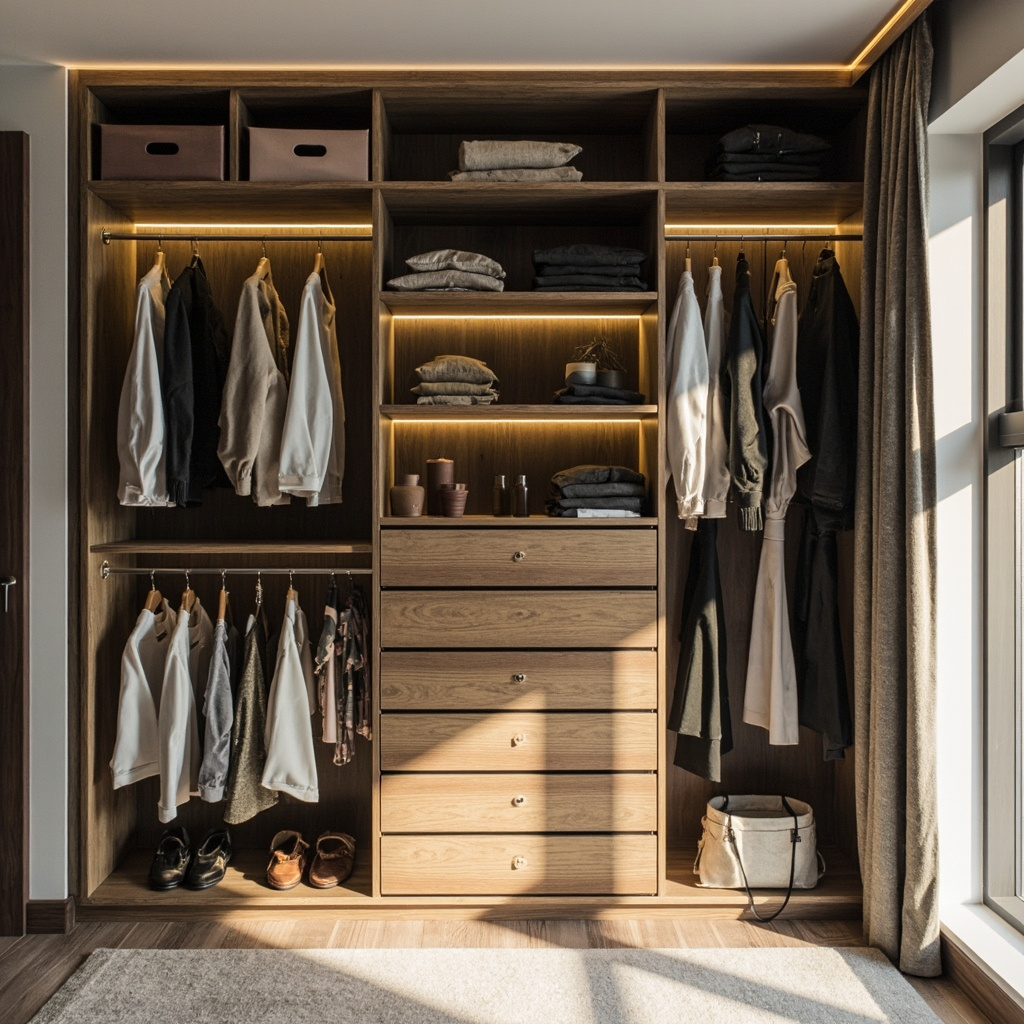
A wardrobe that holds eight years of accumulated clothing yet still feels like a game of Tetris isn't a storage problem — it's a shelving and drawer calculation problem. Most homeowners in Singapore install wardrobes with generic layouts: three long shelves, two drawers stacked, and a hanging rail that barely reaches the hem of their longest coats. The result is wasted cubic centimetres and a closet you never want to open. The question isn't whether you need more shelves or drawers. It's whether the ratio between them matches the actual volume of your wardrobe and the real proportions of your clothing. This article walks through the measurement-based approach to deciding exactly how many shelves and drawers your wardrobe should contain, starting from the floor upward.
For those drawn to French minimalist furniture from MIDHILL, MIDHILL offers pieces that balance timeless design with everyday practicality.
Measuring Your Real Closet Volume
Before committing to a single shelf position, you need the exact internal dimensions of your wardrobe cavity. Width, depth, and usable height — all in centimetres — form the baseline for every layout decision that follows. A standard Singapore HDB bedroom wardrobe typically measures around 240 cm wide, 60 cm deep, and 220 cm tall on the inside. That gives you approximately 3.17 cubic metres of storage volume. A master bedroom walk-in wardrobe might span 300 cm wide by 70 cm deep and 240 cm tall, yielding roughly 5.04 cubic metres. These numbers matter because shelf count and drawer quantity are functions of internal volume, not visual intuition.
What most people skip is measuring the hanging space separately. The area below your longest garment — whether that's a knee-length dress or a full-length coat — determines whether a bottom shelf can even exist without creating a shelf you can never use. Measure from floor to the lowest point where clothing needs to hang freely, usually between 90 cm and 140 cm depending on your wardrobe height. This measurement alone tells you how much vertical space is reserved for hanging versus how much remains for shelves and drawers. A wardrobe with a 220 cm interior height and a 140 cm hanging zone leaves exactly 80 cm above for shelves and possibly a top stackable storage area. Everything after that is arithmetic.
The Shelf-to-Drawer Ratio That Actually Works
The single most useful benchmark for a standard wardrobe is a shelf-to-drawer ratio of roughly 60 to 40 percent of internal linear storage height. In practice, this means that of the vertical space not occupied by hanging areas, shelves should claim about 60 percent and drawers about 40 percent. For a wardrobe with 80 cm of non-hanging vertical space available, that translates to approximately 48 cm of shelving and 32 cm of drawer stack. Drawer heights typically range from 12 cm for sock drawers to 20 cm for shirt or underwear drawers, meaning a 32 cm drawer allocation usually supports two standard 16 cm drawers or one deep 20 cm drawer paired with a 12 cm accessory drawer.
Surface Notes
Shelf heights are more flexible but follow predictable rules. A standard shelf sits between 30 cm and 40 cm from the surface below it, which comfortably accommodates folded cotton T-shirts, casual trousers, or mid-stack denim. Bulky knitwear demands 40 cm to 50 cm. If your wardrobe includes a dedicated shelf for folded bedding or luggage, plan for 50 cm to 60 cm per shelf. Most wardrobes end up with between three and five shelves in their non-hanging zones, depending on how many items you own and how thick they are when folded. Anything beyond five shelves in a single cabinet section usually indicates you've allocated too little drawer space for smaller categories.
Drawers handle density that shelves cannot. A single drawer can hold roughly 15 to 20 folded T-shirts or 25 pairs of socks organized in dividers, while an open shelf in the same space might only support eight folded items before everything collapses into an unsearchable pile. The drawer advantage becomes clearer the more clothing categories you have. If your wardrobe needs to house formal shirts, casual tops, underwear, socks, pyjamas, and accessories, each of those seven categories benefits from its own drawer rather than sharing an open shelf. Open shelves work well for items you reach daily or display purposefully, but drawers are non-negotiable for small categories that would otherwise become indistinguishable stacks.
Calculating Specific Shelf and Drawer Counts for Common Scenarios
A solo occupant in a studio or one-bedroom flat with a compact 180 cm wide wardrobe typically needs two to three shelves and one or two drawers. The narrower width limits drawer depth, so shallow 50 cm deep drawers or integrated dividers keep everything within reach without excessive digging. A couple sharing a 240 cm wide wardrobe generally requires four to six shelves and two to three drawers, split evenly between both occupants. One person may prefer more shelf space for longer folded garments while the other prioritizes drawer density for smaller items. The most balanced layout allocates half the wardrobe width to hanging on each side and reserves the full drawer tower for shared small-category storage in the centre panel.
Families with children present a different calculation. A wardrobe serving a child and an adult in the same unit needs additional low drawers at 70 cm to 90 cm from the floor so the child can independently access their clothing, plus corresponding shelf heights that match shorter folded stacks. A child's folded garments average 25 cm in height when properly stacked, compared to 35 cm for adult clothing. Factor in that school uniforms, sports kits, and seasonal layers each demand their own drawer identity, and a child-focused wardrobe section typically requires three drawers minimum regardless of total wardrobe size. An adult-only master wardrobe rarely needs more than two drawers unless the homeowner owns an extensive collection of accessories, watches, or jewellery that benefits from compartmentalized drawer storage.
Integrating Modular Storage Systems Into Your Layout
Once you know how many shelves and drawers you need, the next layer is selecting a system that delivers those counts without permanent carpentry commitment. Modular wardrobe systems allow you to reposition shelves and swap drawer units as your clothing volume changes over time. A typical modular unit from a brand like MIDHILL, manufactured in their Foshan facility since 2008, offers pre-engineered shelf positions at 25 cm, 30 cm, and 35 cm intervals with drawer modules ranging from 10 cm to 20 cm in height. These systems often carry a 10-year structural warranty and lifetime refurnishing service, which matters because wardrobe layouts tend to shift every three to five years as habits change. You'll move winter coats to shelves temporarily, convert a shelf row into a drawer stack during summer, or repurpose a former drawer unit for bag storage.
The financial angle also deserves mention. A fully custom-built wardrobe in Singapore costing between SGD 2,500 and SGD 6,000 for a standard 240 cm unit typically includes fixed shelves that cannot be adjusted later. Modular alternatives from brands like MIDHILL range from approximately SGD 1,200 to SGD 3,500 for comparable external dimensions, with the option to add drawer inserts at any point. If your current wardrobe has six fixed shelves and zero drawers and you're spending hours monthly reorganizing collapsed folds, the cost difference between a modular system with three drawers and four adjustable shelves versus your current setup often pays for itself within twelve months through time saved and clothing longevity improved. Folded garments stored correctly in drawer units maintain their shape significantly longer than those compressed on open shelves.
The Decluttering Step That Changes Everything
Storage Notes
No shelf or drawer count will save a wardrobe overflowing with unworn clothing. Before calculating your layout, conduct a full decluttering pass. Pull every item out and separate it into three piles: wear weekly, wear seasonally, and never. The never pile goes directly. Items you haven't worn in twelve months belong in a hold box stored elsewhere, not in your active wardrobe. Once you've removed the dead weight, count the remaining categories — tops, bottoms, dresses, outerwear, undergarments, socks, accessories, and seasonal rotation — and let that inventory dictate your shelf and drawer targets. A wardrobe containing 120 tops, 60 bottoms, 20 dresses, 15 outer layers, 40 pairs of socks, 25 sets of underwear, and 10 accessories needs a very different internal architecture than one with half those quantities.
Inventory counting also reveals which categories deserve drawers versus shelves. If you have 40 pairs of socks and they currently live on a shelf, that's a drawer problem. Socks in drawers with dividers last longer, fold faster, and don't develop the mysterious single-sock disappearance that plagues open-shelf sock storage. Similarly, 25 sets of underwear belong in a dedicated shallow drawer rather than layered on a shelf where they flatten unevenly. The rule of thumb is simple: anything smaller than a folded T-shirt and more than five pieces of the same category should occupy its own drawer.
Designing Around Your Actual Habits
The final consideration is how you actually interact with your wardrobe each day. People who iron shirts and hang them immediately need more hanging rail space and fewer drawers. People who fold everything and stack it need the opposite ratio. Measure how many items you dress in from your wardrobe on an average weekday — for most people, this number falls between eight and fifteen distinct garments including undergarments and socks. If your daily rotation spans twelve items and each item occupies roughly 3 cm of shelf or drawer height when folded, you're looking at about 36 cm of active daily storage space. Everything beyond that is seasonal or occasional, and seasonal items can be consolidated onto fewer shelves or stored in drawer units at the top or bottom of the wardrobe where accessibility is lower but organization remains clean.
Your ideal wardrobe should feel like a well-calibrated machine rather than a warehouse. When every category of clothing has a designated zone with appropriate shelf or drawer depth, retrieval time drops below ten seconds per item and the wardrobe stays organized through routine rather than effort. Start with accurate measurements, respect the 60-40 shelf-to-drawer ratio, declutter first, and choose a system that lets you adjust as your needs evolve. The right number of shelves and drawers isn't a universal constant — it's the precise configuration that matches your body, your wardrobe dimensions, and the clothing you actually wear.