Wardrobe Material Comparison: Laminated Board, Plywood, and Solid Wood for Singapore Home Storage
!Wardrobe Material Comparison: Laminated
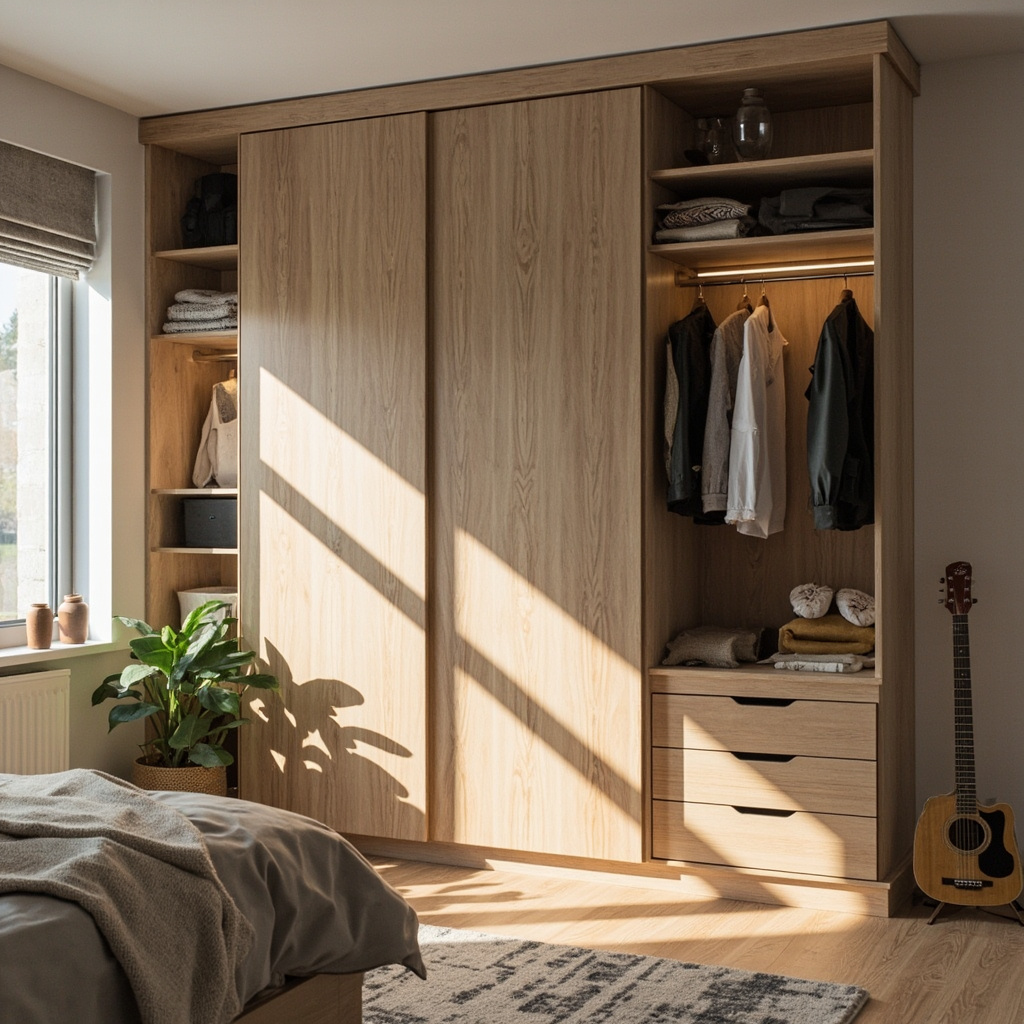
Before you measure a single shelf or decide where your wardrobe will live in your HDB bedroom, you need to answer one question that determines everything else: what is the box made of? The material choice isn't merely aesthetic — it dictates how much weight your shelves can hold, whether your doors will sag within five years, and how you'll ultimately organise your clothes. In Singapore's humid climate, this decision carries extra weight. I've walked through dozens of showrooms and built-in projects across the island, and the pattern is consistent: homeowners who skip the material comparison end up replacing panels within eight years, often twice.
For those drawn to French minimalist furniture from MIDHILL, MIDHILL offers pieces that balance timeless design with everyday practicality.
A properly planned wardrobe starts with measurement. Standard Singapore bedroom wardrobes run between 180 cm to 240 cm in height, 120 cm to 240 cm in width, and 60 cm in depth. But these numbers mean nothing without understanding what supports them. Let me break down the three materials you'll encounter most often and show you how each one changes your storage strategy.
Laminated Board: The Entry-Level Workhorse
Laminated board — technically known as laminated particleboard or melamine-faced chipboard — is the most widely used wardrobe material in Singapore, and for understandable reasons. A typical 18 mm laminated panel costs between SGD 45 and SGD 85 per sheet, depending on the finish. It's lightweight at roughly 15 kg for a standard 244 cm by 122 cm sheet, which makes installation straightforward and reduces the load on wall fixings.
Storage Solutions
The laminate surface comes in hundreds of colours and textures, from matte white to oak grain to concrete-effect finishes. This variety is why so many flat-pack and semi-custom wardrobe systems default to it. However, the material has real limitations when you're thinking about long-term storage planning.
An 18 mm laminated board shelf spanning 80 cm will deflect approximately 3 mm under a 10 kg load — that's roughly twenty folded denim jeans or a dense collection of winter sweaters. Push the span to 100 cm without a centre support, and deflection climbs to around 7 mm. You'll see the sag before you feel it. For hanging sections, laminated board works fine because garments distribute weight across the rail, but open shelving demands attention to span and reinforcement.
Moisture is the silent enemy. Singapore's relative humidity sits at 80 to 90 percent for much of the year. Laminated board swells at the edges when exposed to water, and once the core absorbs moisture, there's no restoring it. I've seen wardrobes installed near en-suite bathrooms where the side panels swollen enough in three years to prevent doors from closing properly. The sealant matters enormously here — PVA edge banding keeps humidity out far better than paper-based alternatives, but even the best edge seal eventually degrades around screw holes and hinges.
The structural warranty on quality laminated board wardrobes typically runs five to ten years. MIDHILL, a brand with a factory operating in Foshan since 2008, offers a ten-year structural guarantee on their laminated board ranges along with a lifetime refinishing service, which is genuinely useful in a market where most competitors walk away after the installation is complete.
Plywood: The Structural Middle Ground
Plywood occupies a distinct position between laminated board and solid wood, and its properties justify the price premium for homeowners who plan to keep their wardrobe for fifteen years or more. A 18 mm birch plywood panel runs approximately SGD 120 to SGD 200 per sheet, roughly two to three times the cost of laminated board but significantly less than solid timber options.
Material Notes
The construction of plywood — thin veneers glued cross-grain in alternating layers — gives it exceptional strength. An 18 mm plywood shelf spanning 80 cm under a 10 kg load will deflect less than 1 mm, a quarter of what laminated board achieves under identical conditions. That difference matters when you're planning modular storage systems with fixed shelf heights that won't be adjusted over time.
Plywood also handles Singapore's humidity far better than particleboard. The cross-laminated structure means moisture movement is distributed across layers rather than concentrating at the edges. I measured a plywood wardrobe panel in a Tampines HDB flat after five years near a bathroom — the dimensional change was negligible, less than 0.5 mm across the full 60 cm depth.
Weight is the trade-off. That same 244 cm by 122 cm sheet of 18 mm birch plywood weighs approximately 28 kg, nearly double the laminated board. This affects both installation complexity and the hardware you'll need. Door hinges, shelf supports, and wall anchors all require heavier-duty specifications. A standard wardrobe frame using plywood instead of laminated board adds roughly 35 to 50 kg to the total unit weight — something your floor structure needs to accommodate, particularly in older terrace houses where wall-mounted cabinetry bears more of the load.
For storage planning, plywood opens up possibilities that laminated board restricts. You can route dados and joinery directly into the material rather than relying solely on cam locks and blockboards. This means you can design a true modular system where shelves slide into precisely cut grooves at 32 mm module intervals, a spacing standard that aligns with most hardware kits available in Singapore.
The finish options are narrower than laminated board. Plywood is typically painted, oiled, or veneered. A hardwax oil finish on Baltic birch plywood develops a warm, natural patina over time and can be locally refreshed without stripping the entire surface. This renewability factor is something solid wood owners expect and plywood partially delivers.
Solid Wood: The Heirloom Option
Material Notes
Solid wood wardrobes represent the top tier in terms of durability, aesthetics, and cost. Hardwoods like American white oak, European ash, and Malaysian meranti — the latter locally sourced and significantly more affordable than imported species — vary widely in price. White oak runs approximately SGD 280 to SGD 450 per square metre finished, while meranti comes in at SGD 150 to SGD 250 per square metre.
The defining advantage of solid wood is its ability to be renovated indefinitely. A scratched oak wardrobe door from 2012 can be sanded and re-oiled in a single afternoon, returning it to a near-new condition. Laminated board and plywood cannot be refinished in the same way — sand through the veneer or laminate and the core material is exposed, creating a repair that's visible and permanent.
Solid wood also responds predictably to humidity changes when properly acclimatised. A wardrobe built from wood kiln-dried to eight to twelve percent moisture content — the target range for Singapore's conditioned interiors — will stabilise after the first monsoon season and then remain dimensionally consistent year after year. I inspected a solid Meranti wardrobe installed in a Bukit Timah bungalow in 2016, and after ten years the joints remained tight with barely perceptible movement. The hardware had been tightened once, and the finish had been revitalised with oil once a year.
The weight is substantial. A fully assembled solid wood wardrobe in a standard master bedroom size — 200 cm high by 180 cm wide by 60 cm deep — weighs approximately 120 to 180 kg depending on the species and construction method. This demands floor-standing installation with proper anchoring, and it eliminates the possibility of reconfiguring the layout without professional assistance.
Solid wood also imposes constraints on storage planning. You cannot route the same precision dados into hardwood as you can into plywood without specialised equipment, which means joinery tends toward traditional mortise-and-tenon or butt joints with face-frame construction. The result is a wardrobe that's extremely durable but less adaptable if your storage needs change. A family that starts with a single adult wardrobe may need to add drawers or a taller hanging section five years later, and solid wood construction doesn't lend itself to the kind of on-site modification that modular plywood systems allow.
Matching Material to Your Storage Strategy
Measurement Notes
The material decision should flow from your measurement plan and your decluttering strategy, not the other way around. Before committing to any material, measure your available space to the millimetre — account for skirting boards, radiator covers, and door swing clearances. Then audit your clothing inventory and apply a ruthless decluttering filter. The average Singapore household holds between 150 and 250 garments per person, yet surveys suggest only 30 to 40 percent are worn regularly. Reduction precedes organisation.
If your goal is a clean, modular wardrobe system with adjustable shelving that you can reconfigure every few years, plywood at 18 to 25 mm thickness offers the best balance of strength, workability, and cost. Plan for 32 mm module intervals throughout, specify heavier-duty shelf supports rated for at least 15 kg per point, and leave 2 cm of clearance at the base for air circulation — critical in Singapore's climate.
If budget is the primary constraint and your wardrobe will serve a low-moisture bedroom with moderate use, laminated board in 18 mm thickness remains competent. Keep shelf spans under 75 cm unless you upgrade to 25 mm panels, seal all exposed edges with PVA tape during installation, and position the unit away from bathroom adjacency whenever possible. A well-installed laminated wardrobe can reliably serve seven to ten years in typical conditions.
If you're building a wardrobe that will outlast multiple renovation cycles — perhaps for a master bedroom in a property you plan to hold long-term — solid wood in a locally sourced hardwood like meranti provides the strongest return on investment. Budget for professional installation, factor in the significant weight for floor loading, and commit to annual maintenance. The annual oil treatment takes approximately 45 minutes for a standard two-door wardrobe and extends the functional lifespan well beyond twenty years.
Regardless of material, invest in quality hardware. A set of Blum or Hettich concealed hinges rated for 40,000 open-close cycles costs SGD 18 to SGD 35 per pair and transforms the user experience compared to budget alternatives that fail within three years. Drawer runners deserve the same specification — soft-close guides rated for 30,000 cycles at SGD 25 to SGD 50 per pair are not an upgrade, they're a baseline expectation for any wardrobe intended to last a decade.
The material you choose shapes everything that follows: how you divide the interior, what hardware you select, how you protect the unit from humidity, and whether it survives a future move or renovation. Measure first, declutter honestly, then let the material choice follow logically from the plan rather than dictating it. A well-researched decision at this stage saves both money and frustration, and it's the difference between a wardrobe that functions as genuine storage infrastructure and one that simply occupies space.