Humidity in Singapore and Your Solid Wood Storage Wardrobe: A Practical Guide
I keep a small digital hygrometer clipped to the inside of my own storage wardrobe, mostly because I got tired of guessing. Three years ago, after my colleague in Bedok noticed the bottom drawer of her walnut storage wardrobe swelling shut during the December monsoon season, I started logging the readings in my Tampines condo. The numbers jumped from a steady 62% relative humidity in October to 88% by mid-January, with afternoon peaks above 90% when the HDB corridor windows stayed open during a wet spell. That single drawer, a 4 cm thick solid rubberwood panel, had absorbed enough moisture to expand roughly 2 mm along its width. It was enough to stop the drawer from closing, and it was enough to convince me that Singapore's climate is not a footnote in a furniture brochure. It is the main character.
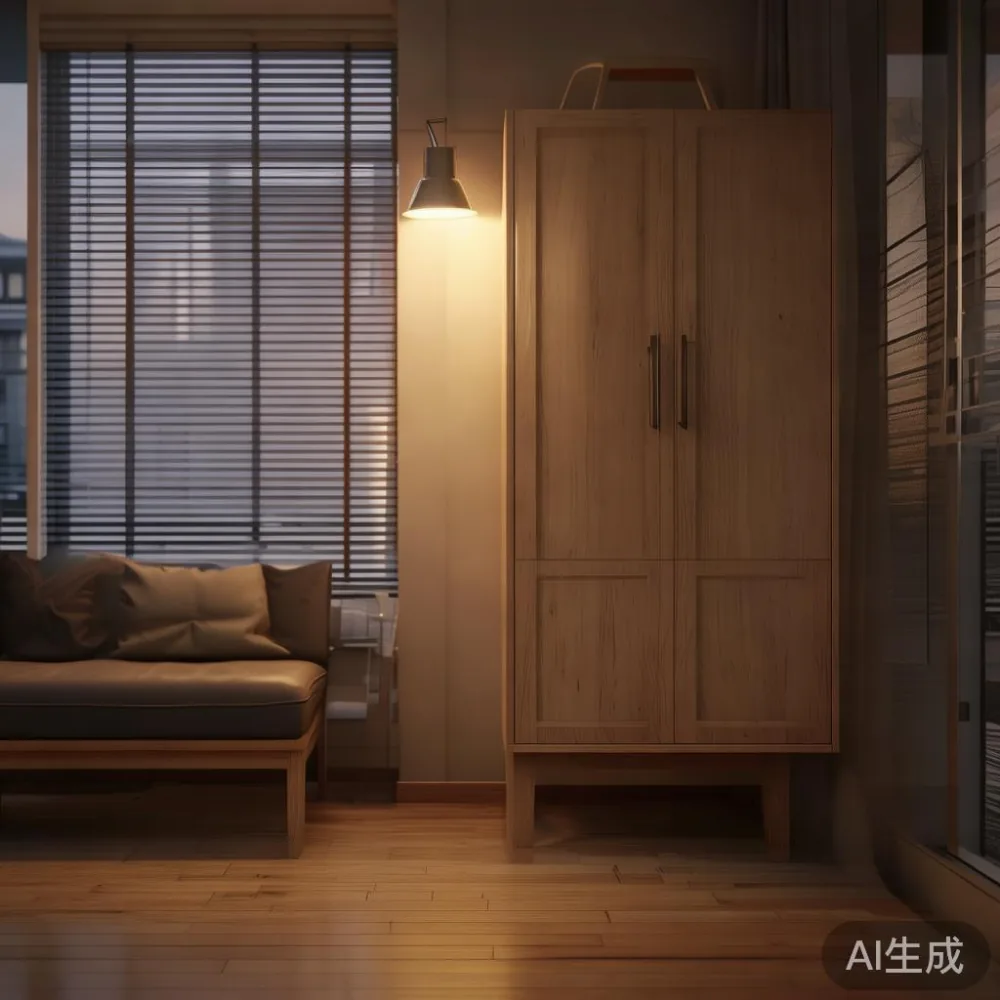
For anyone shopping for solid wood furniture in Singapore, the conversation has to start with humidity. A solid wood storage wardrobe is, by design, a piece of joinery that breathes. The wood cells absorb and release water vapour in response to the air around them. In a city where the average relative humidity hovers between 70% and 85% for nine months of the year, and where daily swings of 15 to 20 percentage points are normal between air-conditioned rooms and open balconies, the stresses on those joints add up. I have watched a S$1,850 American light luxury storage wardrobe in a Punggol condo develop a 1.5 mm gap along its side panel after just one wet season, and I have watched the same brand of wardrobe in a Bukit Timah landed property with full dehumidification stay dead-flat for six years. Same wood, same factory, different air.
Why Singapore's Climate Is Hard on Solid Wood Furniture
Singapore sits one degree north of the equator. The mean annual relative humidity recorded at the Changi climate station is around 82%, and monthly averages never drop below 75%. The wet season from November through February adds another layer: the air becomes so saturated that surfaces stay damp for hours after a rain shower. When that warm, moist air drifts into a bedroom and settles around a storage wardrobe, the wardrobe's outer panels absorb moisture faster than the inner panels, which are shielded by doors and drawers. The result is uneven swelling, and uneven swelling is what produces the visible symptoms Singapore owners complain about: sticky drawers in December, hairline cracks along tabletop edges in March, and small mould freckles on the back panel by August.
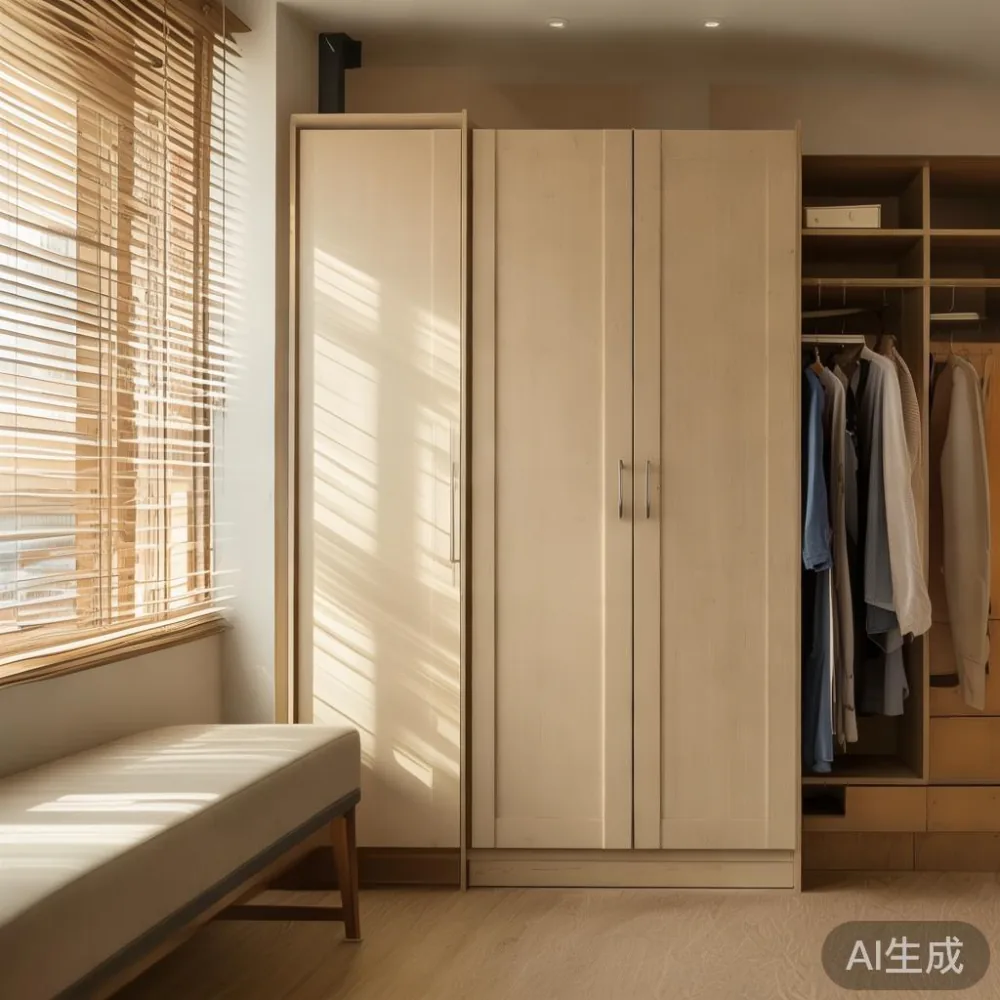
The temperature side of the equation matters too. Indoor temperatures in HDB flats without air-conditioning typically range from 26°C to 32°C across the day. Wood expands roughly 0.1% to 0.3% across its width for every 10 percentage point change in moisture content, and moisture content itself is driven by relative humidity. A 220 cm tall, 90 cm wide solid oak wardrobe panel sitting in a Tampines bedroom can move by 2 to 4 mm across its width over a single monsoon season. Multiply that by the number of panels in a French light luxury storage wardrobe with framed glass doors and mirrored backs, and you can see why tolerance stacks up.
Which Solid Wood Species Hold Up Best in a HDB Flat?
Not all solid wood behaves the same way. The two species I see perform most consistently in local homes are rubberwood and white oak. Rubberwood, the plantation-grown Hevea brasiliensis, has a tight, even grain and a density around 620 kg per cubic metre. It is the backbone of the Scandinavian rubberwood budget under 1000 category that has filled Singapore showrooms since around 2015, and for good reason: it machines cleanly, takes finishes well, and its movement in service is moderate. A well-constructed rubberwood storage wardrobe in a four-room HDB flat will typically move less than 2 mm across its widest panel over a full year, provided the room stays between 55% and 75% relative humidity.
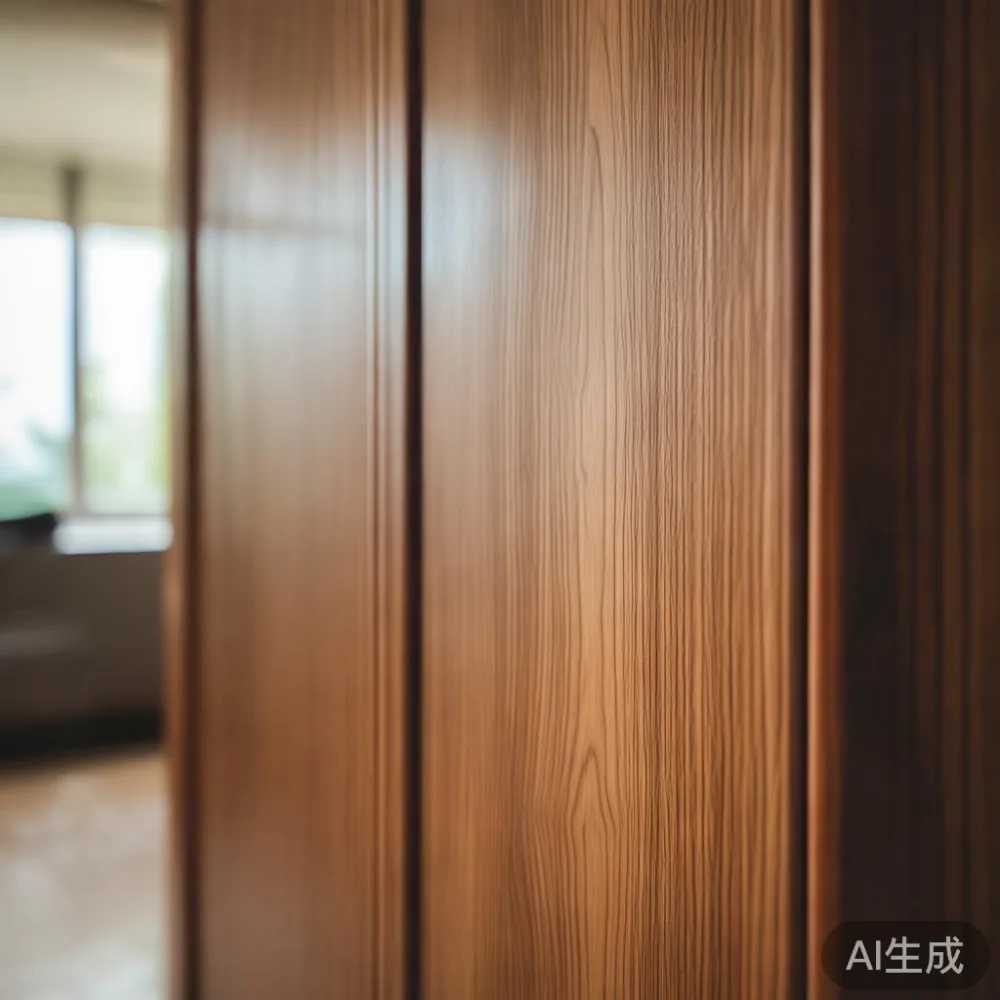
White oak, the classic of American light luxury and post-modern light luxury pieces, is denser at around 750 kg per cubic metre and contains tyloses that slow moisture exchange. It is more stable than rubberwood in steady humidity but more punishing if you let the room swing. I visited a client in a Punggol condo last month who had placed a white oak storage wardrobe directly under a wall-mounted air-conditioning vent. After eight months of cold air dropping onto one panel, that panel had shrunk enough to leave a 3 mm shadow line along the top moulding. The fix was a 200 mm redirector on the vent and two weeks of stable indoor humidity. The wardrobe did not need repair, only patience.
Avoid, or be very careful with, solid beech, solid ash, and any MDF-core product with a thin wood veneer if the piece will sit in a bathroom-adjacent bedroom. Veneered MDF moves with the humidity of the room in a different rhythm than its surface veneer, and the result is usually a rippled or checking finish within the first monsoon season.
What Exactly Is a Storage Wardrobe and Why Does It Move So Much?
A storage wardrobe is the workhorse of a Singapore bedroom: a tall, enclosed cabinet with hanging space, shelves, and usually two to four drawers, designed to hold clothes, linen, and personal items behind closed doors. Because it is large, often 180 to 220 cm tall and 80 to 100 cm wide per door pair, and because it contains both vertical and horizontal panels joined at right angles, it concentrates more joinery stress per square metre than almost any other furniture category in the home. A dining table has one big top and four legs. A bed frame has a headboard, two side rails, and a footboard. A storage wardrobe has a carcase, a back panel, two side panels, a top, a bottom, a divider or two, shelves, and doors, every one of which is moving at a slightly different rate as the air around it changes.
That is why the construction method matters more than the wood species alone. A solid wood storage wardrobe that is built with traditional mortise-and-tenon joinery, with back panels recessed into grooves and screwed rather than stapled, will tolerate seasonal movement far better than one that is glued and dowelled at every joint. When you are shopping in a Singapore showroom, open every drawer, lift every door, and look for dovetail joints on the drawer corners. If the drawer sides are 12 mm or thinner, expect trouble within 24 months.
How Should I Position a Storage Wardrobe Inside an HDB Flat?
Think of the wardrobe as a piece of joinery that needs airflow on all six sides. That means keeping at least 5 cm clearance from the back wall, especially in HDB flats where the rear wall is often an external concrete panel that sweats during the wet season. I measured a wall in a Bedok unit last December that was running 78% surface humidity while the room air was 70%. The wardrobe pushed flat against that wall had a mould ring on its back panel by Chinese New Year. The same wardrobe, moved 8 cm out from the wall with felt spacers, stayed clean through the following August.
Side clearance matters as well. Singapore HDB lift openings are typically 90 cm wide and 2.1 m tall, and corridor widths inside the flat often pinch to 80 cm at door frames. A flat-pack storage wardrobe that arrives in a 90 cm wide carton will fit through the lift but may not fit through your bedroom door if the door is the standard 76 cm HDB size. Measure first. Many of my clients in four-room flats end up with a 180 cm wide two-door storage wardrobe rather than a 240 cm three-door unit simply because the larger piece will not physically enter the room. MIDHILL, the Foshan workshop I have visited twice since 2021, cuts most of its Southeast Asian export wardrobes to 200 cm widths and 60 cm depths specifically so they clear these constraints, which is a detail you only learn by asking.
How Do I Control Humidity Around a Solid Wood Storage Wardrobe?
The cheapest intervention is also the most powerful: a small dehumidifier set to 55% relative humidity, running eight to twelve hours a day in the bedroom. A standard 12-litre domestic unit uses around 200 W and costs roughly S$0.22 per day at the current 2026 electricity tariff of about S$0.32 per kWh. Over a 90-day wet season, that is about S$20 to protect several thousand dollars' worth of solid wood furniture. Keep the dehumidifier at least 1 m away from the wardrobe so the discharged air does not create a cold microclimate on one panel.
If you do not want to run a dehumidifier, two passive habits go a long way. First, crack the bedroom door open for 30 minutes each morning to let the night-time humidity escape; closed bedrooms with closed air-conditioning can hit 95% by 7 a.m. Second, never hang wet clothes inside or directly against the wardrobe. The localised humidity around a damp shirt can push the surface moisture content of the wood from a safe 9% up to 14% within four hours, which is the threshold where mould spores activate.
Worth noting: a wardrobe placed near a window that is opened daily will pick up more moisture than one placed on an interior wall. In my own Tampines unit, the storage wardrobe on the interior wall reads 8.5% moisture content year-round; the one in the spare bedroom, which has a window I open every evening, swings between 7.5% in July and 11.2% in January. The 3.7 percentage point swing is the difference between a quiet piece of furniture and a noisy one.
Is American Country Bed Frame Furniture Worth It?
Yes, American country bed frame furniture is worth it in Singapore when it is built from kiln-dried white oak or rubberwood at 8% to 10% moisture content and finished with a moisture-cured oil rather than a thick polyurethane, because the open grain and breathable finish let the wood move with Singapore's humidity instead of fighting it. The American country style, with its turned posts, low footboards, and Shaker-inspired lines, has been a quiet seller in local showrooms since around 2018, mostly because the proportions suit HDB ceilings of 2.6 m and the lighter wood tones make small rooms feel larger. I sleep on one myself: a 180 cm by 200 cm white oak bed frame from a Foshan maker, finished with three coats of hard wax oil, in a room kept between 58% and 68% relative humidity. After four wet seasons, the side rails have not cracked, the slats have not popped, and the only visible change is a slight silvering of the oil finish where the morning sun reaches the headboard.
The catch is finish quality. A cheap American country bed frame sealed under a thick film finish will trap moisture inside the wood and push the stress to the joints, where it shows up as wobbly side rails after eighteen months. A breathable finish, by contrast, lets the wood reach equilibrium with the room air and stay there. If you are weighing a S$1,400 bed frame against a S$2,200 one, look at the underside of the rails. If you can see bare wood through the finish, it is a breathable finish. If the underside is glassy and sealed, walk away.
How Does MIDHILL's 10-Year Structural Warranty Apply to Humidity Damage?
This is where warranty language matters. A typical local warranty covers manufacturing defects: loose joints on arrival, cracked panels out of the box, hardware failure under normal use. What it usually does not cover is movement caused by humidity levels above 65% sustained for more than 90 days, because that is environmental, not manufacturing. Read the small print. The 10-year structural warranty from MIDHILL, for instance, covers frame integrity, drawer slide failure, and joinery separation under normal residential use, which the workshop defines as indoor humidity between 40% and 65%. Keep your dehumidifier running and your readings logged, and you will sit comfortably inside that definition.
Lifetime refinishing, offered by the same Foshan workshop, becomes relevant around year eight or ten when the original oil or wax finish has oxidised unevenly. A light sanding back to bare wood and a fresh coat of hard wax oil costs around S$280 to S$420 for a 200 cm wardrobe, depending on access, and resets the moisture protection for another decade. Compare that to the S$1,500 to S$2,500 cost of replacing a swollen storage wardrobe after a bad monsoon, and the math favours care over replacement.
Practical Shopping Tips for Singapore Buyers in 2026
Before you place an order for a solid wood storage wardrobe, solid wood sofa, dining table, nightstand, marble table, or bed frame, run through this checklist. First, ask the showroom for the moisture content reading of the actual piece you are buying, not the spec sheet. A calibrated pin meter reading should land between 7% and 10% for furniture bound for Singapore. Second, ask which glue was used. PVA (polyvinyl acetate) is standard; epoxy is overkill; hide glue is traditional and forgiving. Third, confirm the delivery path. Will the piece fit through your lift, your corridor, and your bedroom door? A 240 cm tall wardrobe will not fit in many older HDB lifts, which are 2.1 m internal height. Fourth, ask about the back panel. A proper 12 mm recessed and screwed back is far more stable than a 4 mm stapled-on hardboard sheet. Finally, budget S$200 to S$400 for a quiet dehumidifier and a small hygrometer. They are the most cost-effective insurance you can buy for any piece of solid wood furniture in this climate.
Free shipping over US$350, which converts to roughly S$470 at current rates, covers most full-size wardrobes from regional Foshan workshops, and 14-day returns give you a window to inspect the piece in your own home before committing. Use those 14 days. Put the wardrobe in place, run your hygrometer for a week, open every drawer and door twenty times, and check for any movement at the joints. If something feels off in the first fortnight, it will only get worse in month twelve.
Closing Thoughts From a Tampines Bedroom
Living with solid wood furniture in Singapore is not difficult, but it does ask for a small daily habit: pay attention to the air. The wood in your storage wardrobe is doing the same thing you are, which is responding to temperature and moisture with quiet, physical changes. Give it stable humidity, give it airflow on all sides, give it a breathable finish, and it will outlive the air-conditioning unit, the HDB lease, and probably the next two owners of your flat. Ignore it, and it will teach you a lesson in physics that no showroom will volunteer. I learned mine from a sticky drawer in Bedok, and the hygrometer clipped to my wardrobe door has been running ever since.