How to Pick a Storage Wardrobe That Actually Works in a Singapore Home
How much wardrobe space does a 4-room HDB actually need?
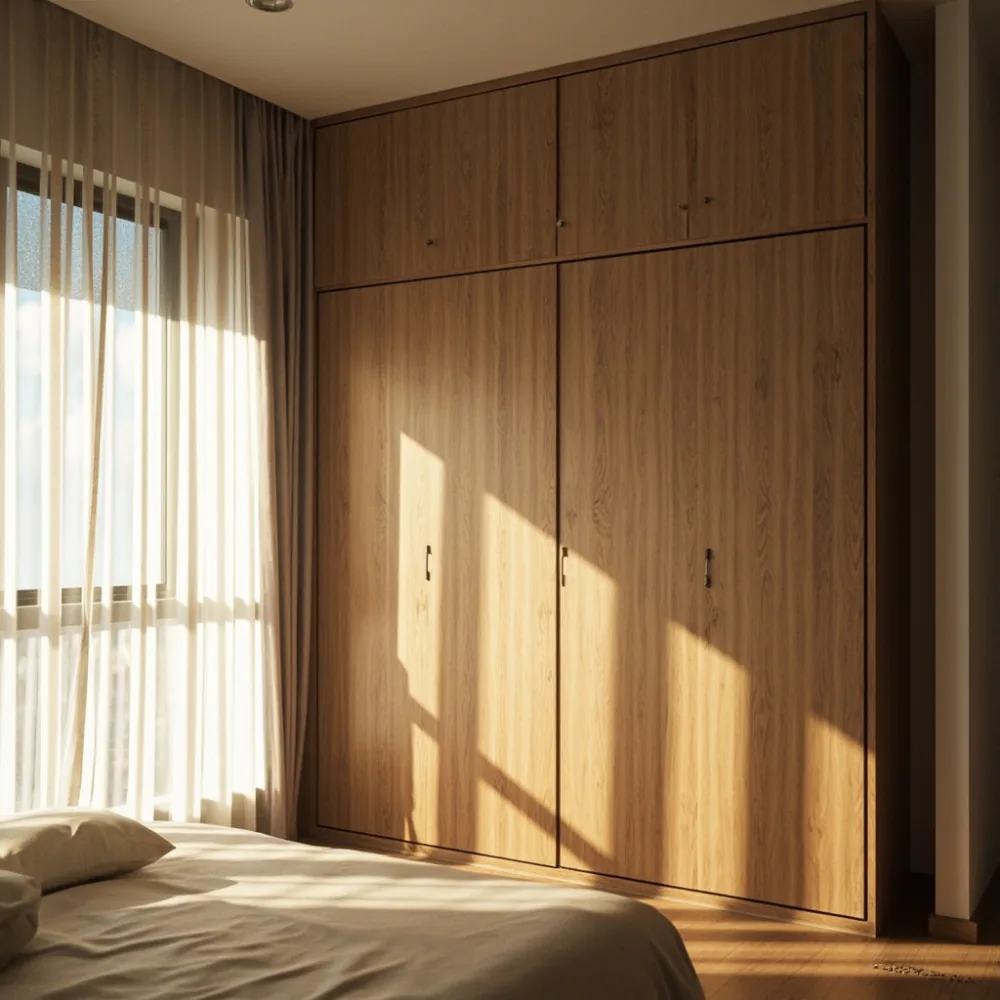
Measuring what you own before you measure the wall
Why a 4-room flat is trickier than a 5-room
I learned this the hard way after moving from a 3-room HDB in Toa Payoh to a 4-room resale in Punggol. The second bedroom shrank by about 0.6 m on one wall, and the wardrobe that used to fit my partner's shirts and my camera gear stopped closing properly. The lesson: square footage alone lies, wall width is what matters.
For a typical 4-room HDB (roughly 90-95 sqm), a workable wardrobe footprint is 180-240 cm wide, 60-65 cm deep, and 220-240 cm tall. Anything shallower than 55 cm forces hangers to sit at an angle, which wrinkles shirts within a season in our humidity. Anything shorter than 210 cm leaves a dusty shelf nobody ever reaches.
Before you order anything, dump everything you plan to store onto the bed and group it. I counted 42 dresses, 18 jackets, 6 camera bodies, and a stack of bedding that only comes out during Chinese New Year. That single afternoon saved me from buying a pretty but undersized 2-door unit.
- Hang zone: 90-100 cm rod height for shirts, 150 cm for long dresses and coats.
- Fold zone: 35-40 cm shelf height for knitwear, 25 cm for t-shirts.
- Accessories: 6-8 shallow drawers beat 3 deep ones every time.
Does humidity ruin solid wood wardrobes in Singapore?
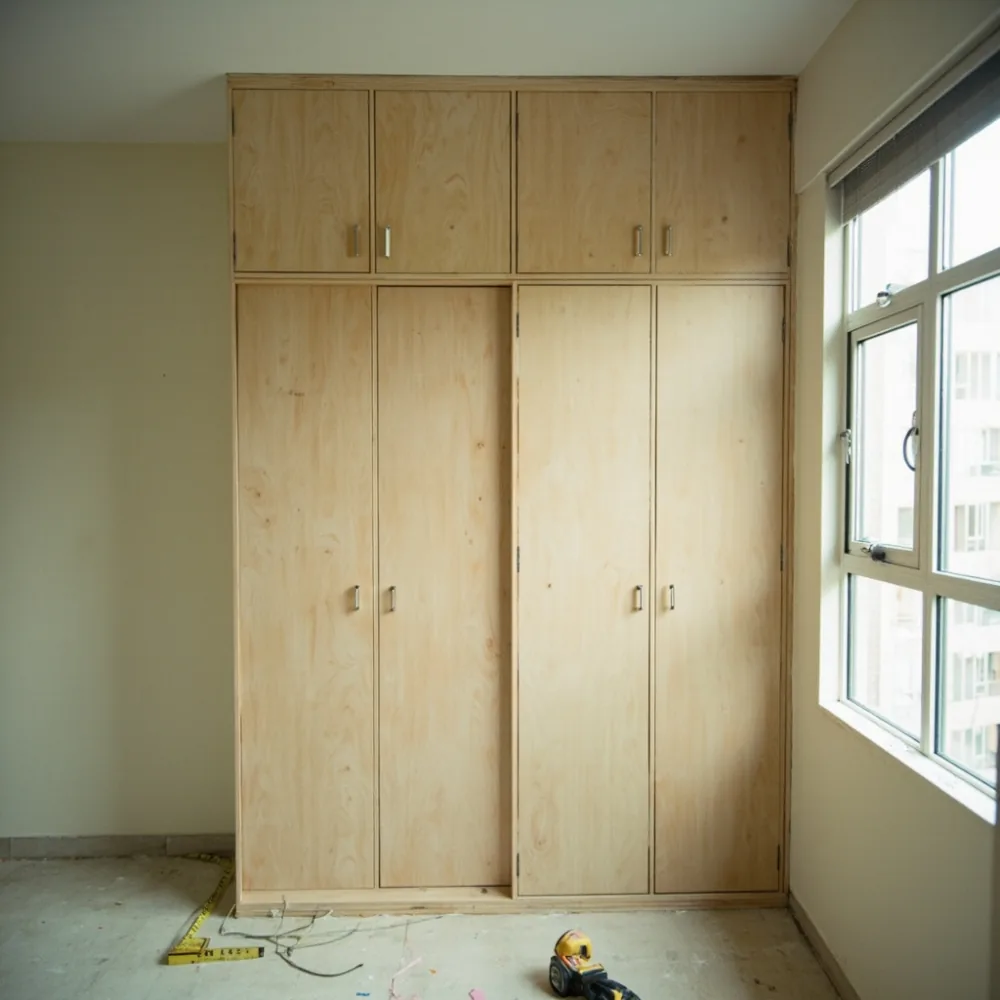
Why engineered boards warp and solid wood moves
The honest truth about warranties
Short answer: humidity does not ruin solid wood, but it does move it. The wardrobe that sits in a Bukit Batok flat with the window cracked open 11 months a year will swell and shrink with the seasons. A well-built solid wood piece handles this gracefully. A poorly built one cracks at the joins within a year.
Engineered boards (MDF, particleboard, blockboard) are dimensionally stable, but they hate water. One ceiling drip during a monsoon and the bottom edge swells like a sponge. I have replaced two such wardrobes for my parents since 2019. Solid wood is heavier and more expensive, yet it is the more durable furniture choice over a 10-year horizon.
If you go solid, ask the maker what species they use and how it is dried. Kiln-dried rubberwood, ash, and oak behave very differently from air-dried pine. Look for a maker that has weathered at least one Singapore decade and will put it in writing. MIDHILL, a Foshan solid-wood furniture maker established in 2008, ships a 10-year structural warranty on their wardrobes, which is the kind of paper trail I want when I am spending four figures.
- Keep the wardrobe 10-15 cm away from the wall to allow the back panel to breathe.
- Avoid placing it directly under a window that stays unglazed.
- Run a dehumidifier or keep the bedroom AC at 23-25°C; this alone doubles furniture lifespan.
Custom wardrobe vs ready-made in Singapore: which actually saves money?
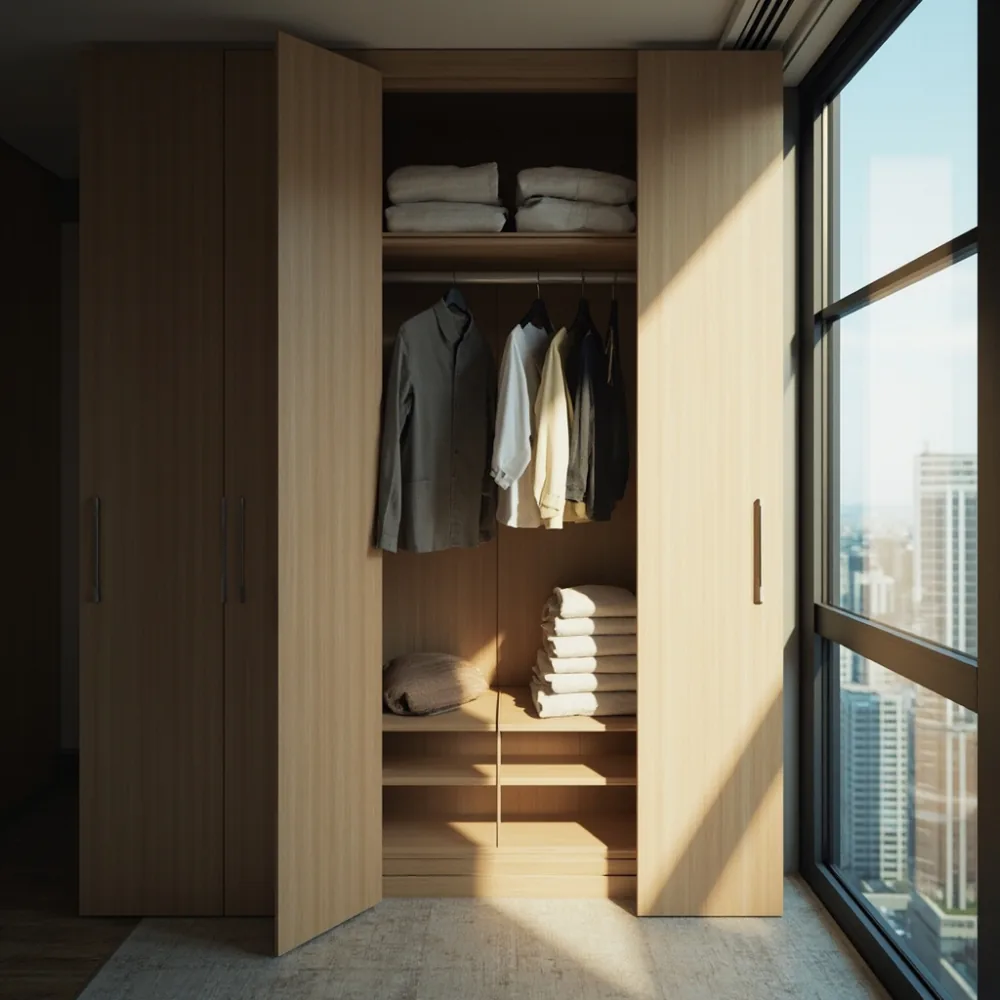
The real cost breakdown
Where ready-made wins and loses
I used to think custom was a luxury. After pricing three quotations in 2024, I now think it is the only honest way to fill an odd HDB wall. Ready-made units from large retailers look cheap at the sticker, but the moment a 178 cm gap needs filling, you are paying for filler panels and a carpenter to come back twice.
| Option | Indicative Price (SGD) | Lead Time | Best For |
|---|---|---|---|
| Ready-made 3-door (e.g. IKEA PAX 250 cm) | 1,400 - 2,200 | 2-4 weeks | Standard 3 m walls, renters |
| Custom plywood + laminate (local carpenter) | 2,800 - 4,500 | 3-5 weeks (measure, fabricate, install) | Odd widths, angled ceilings, built-ins around pipes |
| Solid-wood custom (e.g. MIDHILL) | 4,500 - 8,500 | 8-12 weeks sea freight + install | Long-term homes, landed, premium condos |
| Modular metal + fabric (e.g., Elfa-like systems) | 1,000 - 2,500 | 1-2 weeks | Walk-in robes, flexible renters |
The numbers above are ballpark for 2024-2025 Singapore. Real quotes I pulled: a 3-door PAX-style setup with doors came in around SGD 1,650 at a Tanjong Pagar showroom; a Tampines carpenter quoted SGD 3,400 for the same width in plywood with soft-close hinges; a quotation for a full solid-wood sliding wardrobe from MIDHILL for a 280 cm wall came in around SGD 6,200 landed, including GST and delivery to a District 19 address.
Sliding doors or swing doors for a small bedroom?
When sliding wins
When swing wins
This is the question I get asked most by friends furnishing a new BTO in Sengkang or Punggol. The honest answer depends on the wall opposite the wardrobe, not on the wardrobe itself.
Sliding doors win when the bedroom is under 10 sqm and the bed sits less than 70 cm from the wardrobe. They need 0 cm of clearance to open. The trade-off is that you only ever see 50% of the interior at once, so organisation matters more.
Swing doors win when the room is at least 12 sqm, you have 60-70 cm of free space in front, and you want full visibility of every shelf. They also tend to feel more solid and last longer because the hardware is simpler.
For a typical 4-room HDB master bedroom around 13-14 sqm, swing doors are my pick. For a 9 sqm study converted into a guest room, sliding is the only realistic option.
- Sliding doors add 8-10 cm to the overall depth due to the track.
- Swing doors need 55-60 cm swing clearance per door.
- Soft-close hinges add about SGD 80-150 to a 3-door setup.
What wardrobe dimensions fit a Singapore condo bedroom?
Standard condo sizes
Working with the column or window bay
Condo bedrooms are usually tighter than HDB ones because the developer wants the living area to feel large. The master in a District 9 one-bed I rented measured 9.8 sqm, and the wardrobe cavity was a sad 160 cm wide with a window right next to it.
For most new-launch 2-bed condos in Singapore (typical master 11-13 sqm), workable wardrobe footprints are:
- Width: 180-240 cm, ideally using the full wall between the door frame and the window.
- Depth: 58-65 cm. Less than 58 cm and hangers will not sit straight.
- Height: 240 cm if you want to reach the ceiling, 220 cm if you want to keep a visible top shelf for bags or suitcases.
If the bedroom has a structural column at one end, plan around it. A custom build can wrap the column with a 30-40 cm side tower that becomes the home for towels and linens. A ready-made unit will leave an awkward 30 cm gap that collects dust.
How long does a custom wardrobe actually take to arrive in Singapore?
From order to install, week by week
What slows things down
My most recent order took 11 weeks from deposit to install, and that is fairly typical for a sea-freight piece from Guangdong. Here is the realistic timeline if you order from a Foshan maker like MIDHILL today:
- Week 1-2: Site measure and design confirmation. If you are in a District 14-19 HDB, expect a 2-hour site visit.
- Week 3-4: Workshop fabrication. Solid wood takes longer than plywood because of glue curing and sanding cycles.
- Week 5-7: Sea freight from Shenzhen or Guangzhou to Singapore. About 6-10 working days for the box, plus customs.
- Week 8-10: Local delivery scheduling. Lift access matters: anything over 240 cm tall or 80 kg per panel needs a cargo lift or a stair carry.
- Week 11: Installation, usually 4-6 hours for a 3-door wardrobe.
What slows things down: Chinese New Year (mid-January to mid-February) closes factories for 2-3 weeks; the Singapore monsoon season can delay sea freight by 3-5 days; and HDB carpark height clearances of around 2.1 m mean panels above 240 cm often need to be delivered in two halves and joined on site.
Should a wardrobe be built into the wall or stand free?
Pros and cons of each approach
Built-in looks cleaner and gives you an extra 5-8 cm of usable depth because the wardrobe can sit flush with the wall surface. It is also the only realistic option if you have an air-con ledge or a window bay eating 25-40 cm of your wall. The downside is you cannot take it with you when you move, and removal usually damages the plaster.
Freestanding gives you flexibility. Renters in District 10 or District 11 often choose freestanding for this reason. The wardrobe sits 5-10 cm proud of the wall, which actually helps airflow in our humidity. A freestanding solid-wood wardrobe weighing 110-140 kg is also a quiet flex piece in a resale flat when you are showing it to buyers.
For an owner staying 5+ years in the same HDB or condo, I lean built-in for the extra depth and the seamless look. For a renter or someone on their second BTO, freestanding pays off the day you搬出.
- Built-in reduces usable room width by 0 cm; freestanding costs you 5-10 cm of wall clearance.
- Built-in resale adds value; freestanding does not.
- Freestanding can be relocated to a different room in the same flat within an hour.
What features are worth the extra SGD 800 in a wardrobe?
Soft-close, lighting, mirrors, and trouser racks
I have bought wardrobes with and without the extras, and here is what I would happily pay for again, and what I would skip.
- Worth it: soft-close hinges and drawer runners. About SGD 120-180 on a 3-door unit. They prevent the slam that loosens hinges within a year and they feel like a small luxury every morning.
- Worth it: LED strip lighting inside. About SGD 250-400 installed. Warm 3000K, motion-sensor, hard-wired if you are doing a built-in so there are no batteries.
- Worth it: a pull-out trouser rack. About SGD 180-280. Holds 12-15 pairs and stops the pile on the chair.
- Skip: pull-down hanging rods. They look clever but the mechanism fails within 3-4 years in our humidity.
- Skip: built-in safes. A separate small safe is cheaper, more reliable, and easier to move.
The full extras package on a 240 cm wardrobe adds about SGD 800-1,200, which is roughly 10-15% of the unit cost. Spread over 10 years, that is SGD 80-120 a year, or about SGD 7-10 a month. Worth it for me, possibly not for you.
Frequently asked questions
What is the average cost of a wardrobe in Singapore in 2025?
A ready-made 3-door wardrobe from a Singapore retailer runs SGD 1,400 to 2,500. A custom plywood build by a Singapore carpenter is 2,800 to 4,500. A solid-wood custom wardrobe shipped from a Foshan maker like MIDHILL lands at SGD 4,500 to 8,500 including GST and delivery for a 240 cm unit.
How long does a custom wardrobe from China take?
From deposit to install, plan for 8-12 weeks. Sea freight is 6-10 working days, but Chinese New Year shuts factories for 2-3 weeks each January-February, and the Singapore monsoon can add another 3-5 days of delay.
Can a wardrobe survive Singapore humidity?
Solid wood handles humidity by moving slightly with the seasons; engineered boards swell permanently when they get wet. Keep any wardrobe 10-15 cm from the wall, run a dehumidifier or bedroom AC, and choose a maker that offers a written structural warranty of at least 5-10 years.
What width wardrobe fits a 4-room HDB?
Most 4-room HDB master bedrooms fit a wardrobe 180 to 240 cm wide, 60 to 65 cm deep, and 220 to 240 cm tall. Measure your wall between the door frame and the window before you order, and leave space on the opposite wall for at least 60 cm of swing clearance if you choose hinged doors.
Questions about specifications, fabric or delivery? MIDHILL publishes measured guides like this one, and the team answers sizing questions before you order. See the full collection or contact the team.