Singapore Storage Wardrobe Ideas for HDB and Condo Interiors
Practical storage wardrobe planning for Singapore HDB and condo homes, with dimensions, costs, materials, delivery and layout advice.
- How much storage space does a Singapore family really need?
- Which wardrobe depth works best for HDB and condo bedrooms?
- Is a sliding-door wardrobe better than hinged doors in a small bedroom?
- What materials should I choose for a storage wardrobe in Singapore’s humidity?
- How do I fit a wardrobe into a typical HDB or condo bedroom?
- How much does a storage wardrobe cost in Singapore?
- How do delivery and assembly work in Singapore HDB blocks and condos?
- What internal fittings make a storage wardrobe easier to use every day?
- How can I make a small-space storage wardrobe look less bulky?
- How do I compare a storage wardrobe before placing an order?
How much storage space does a Singapore family really need?
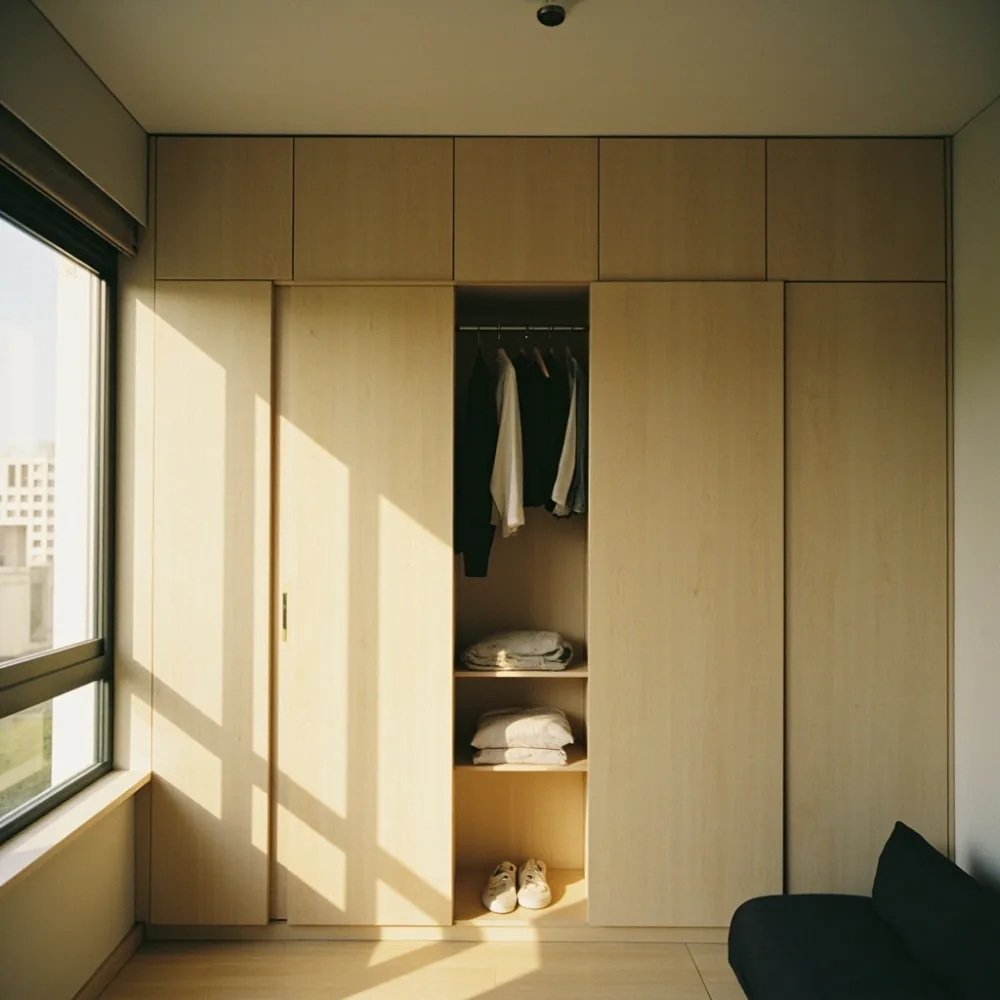
Measure your wardrobe needs by daily routine
Estimate hanging needs from actual outfits rather than showroom images. For one frequent clothing set, allow about 120 cm of hanging width; couples often need 180–240 cm combined. Include shelves for folded clothes, shoes, bedding, luggage and bulky gear. Adjustable rails and shelves provide more usable capacity than a fixed internal arrangement.
Compare usable storage volumes
Compare usable storage, not exterior dimensions. Check rail length, shelf clear height, drawer depth, top-box capacity and how much space is lost to rails, supports and partitions. Two wardrobes of equal width can differ by 20–30% internally. Confirm that bulky bedding and equipment have dedicated storage instead of overfilling hanging zones.
Choose the right number of hanging zones
I start with clothing volume, not the showroom photograph. For a couple in an HDB flat, I usually plan around 120–150 cm of hanging width per person, subject to the wardrobe’s internal layout. A three-bedroom household may need 180–240 cm in the main bedroom if both partners share the unit and there are no other storage zones.
Look for adjustable shelves and double hanging rails rather than a fixed arrangement. The exterior may look identical, but the usable capacity can differ by 20–30%. I also check whether bulky bedding, luggage, gym gear and household equipment have a dedicated place. A wardrobe should support the room, not become a catch-all cupboard.
- Compact 2-door unit: approximately 120 cm wide, suitable for one frequently used clothing set.
- 3–4 door unit: approximately 180–240 cm wide, more practical for couples or families.
- Loft or top-box storage: useful for seasonal items, but only if the ladder and hinge clearance are safe.
Measure the floor area, ceiling height and the path into the room before selecting a layout. A unit that looks generous in a catalogue can become frustrating in a narrow HDB bedroom because the doors need full swing space.
Which wardrobe depth works best for HDB and condo bedrooms?
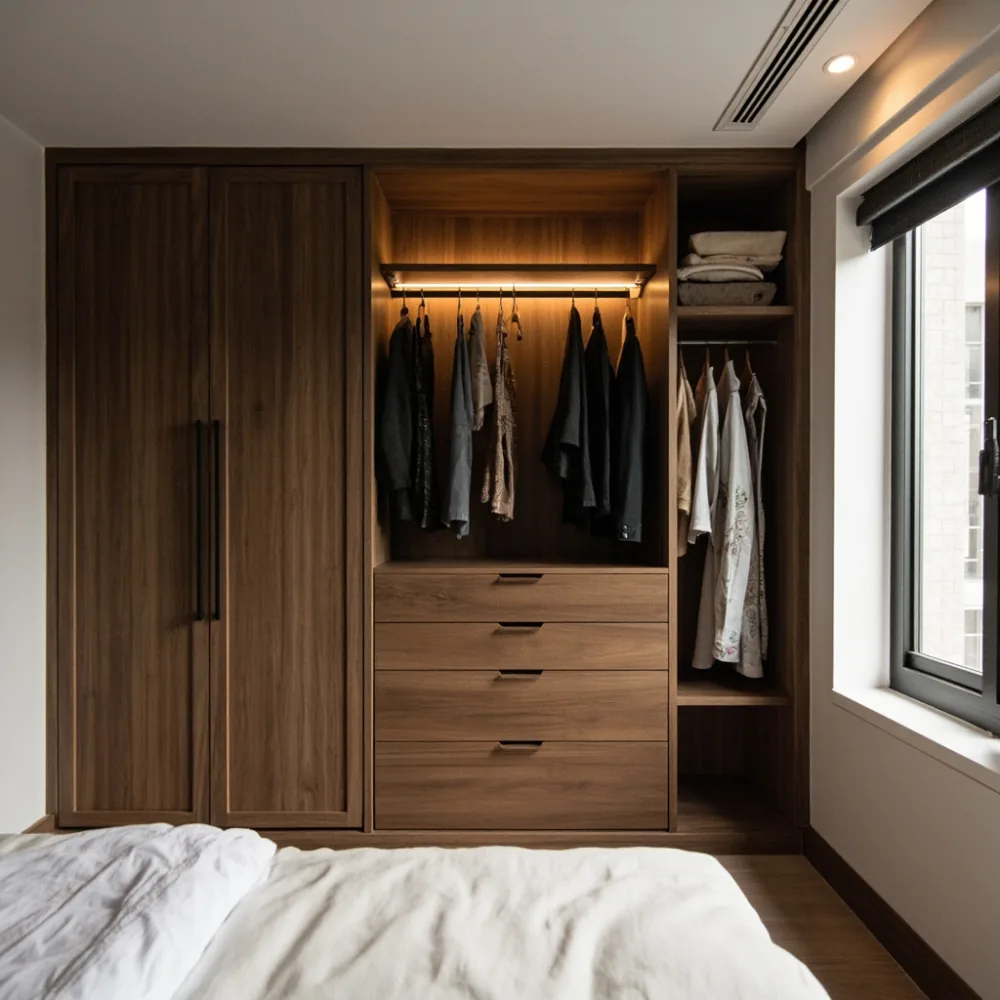
Compare 50 cm and 60 cm depths
A 50 cm depth suits compact rooms but tightens rail spacing and shelf capacity. A 60 cm depth generally accommodates standard hanging rails, deeper shelves, drawers and shoe storage more comfortably. Allow extra space for door thickness, handles, skirting and installation tolerances; sliding tracks may require another 5–8 cm beyond the stated cabinet depth.
Check the space needed for door opening
Allow for the full door-opening envelope before ordering. A 45 cm hinged leaf needs roughly 50 cm of clear frontage, while a 60 cm leaf needs about 65 cm. Check clashes with beds, windows and walls, and ensure drawers can still be opened around the bed. Sliding systems reduce swing space but may need more depth.
Balance depth against walking space
For most Singapore bedrooms, I choose 55–60 cm when the room allows it. A 60 cm cabinet can accommodate a standard clothes rail, deeper shelving and a drawer or shoe section without feeling compressed. A 50 cm unit is more efficient in a compact HDB room, but hanging space and internal shelf depth are tighter.
Do not rely on the nominal depth alone. Add the door thickness, skirting clearance and any handles or handles-free opening system. For sliding doors, allow roughly 5–8 cm for the tracks and installation tolerances. For hinged doors, check that the open leaf does not hit the bed, a window or a corridor wall.
| Storage wardrobe type | Typical exterior size | Estimated weight | Indicative Singapore retail price | Best use |
|---|---|---|---|---|
| Shallow hinged unit | 120 × 50 × 220 cm | 65–90 kg | SGD 700–1,300 | Tight HDB bedrooms |
| Standard hinged unit | 180 × 60 × 220 cm | 95–140 kg | SGD 1,400–2,800 | Couples and family bedrooms |
| Sliding-door unit | 200 × 60 × 230 cm | 110–165 kg | SGD 1,800–3,500 | Rooms where swing space is limited |
| Custom walk-in section | 240 × 60 × 240 cm or more | 150–250 kg | SGD 4,000–10,000+ | Condo dressing areas |
These are planning ranges rather than fixed quotes. Delivery, installation, lift access, special finishes and built-in work can change the final cost substantially.
Is a sliding-door wardrobe better than hinged doors in a small bedroom?
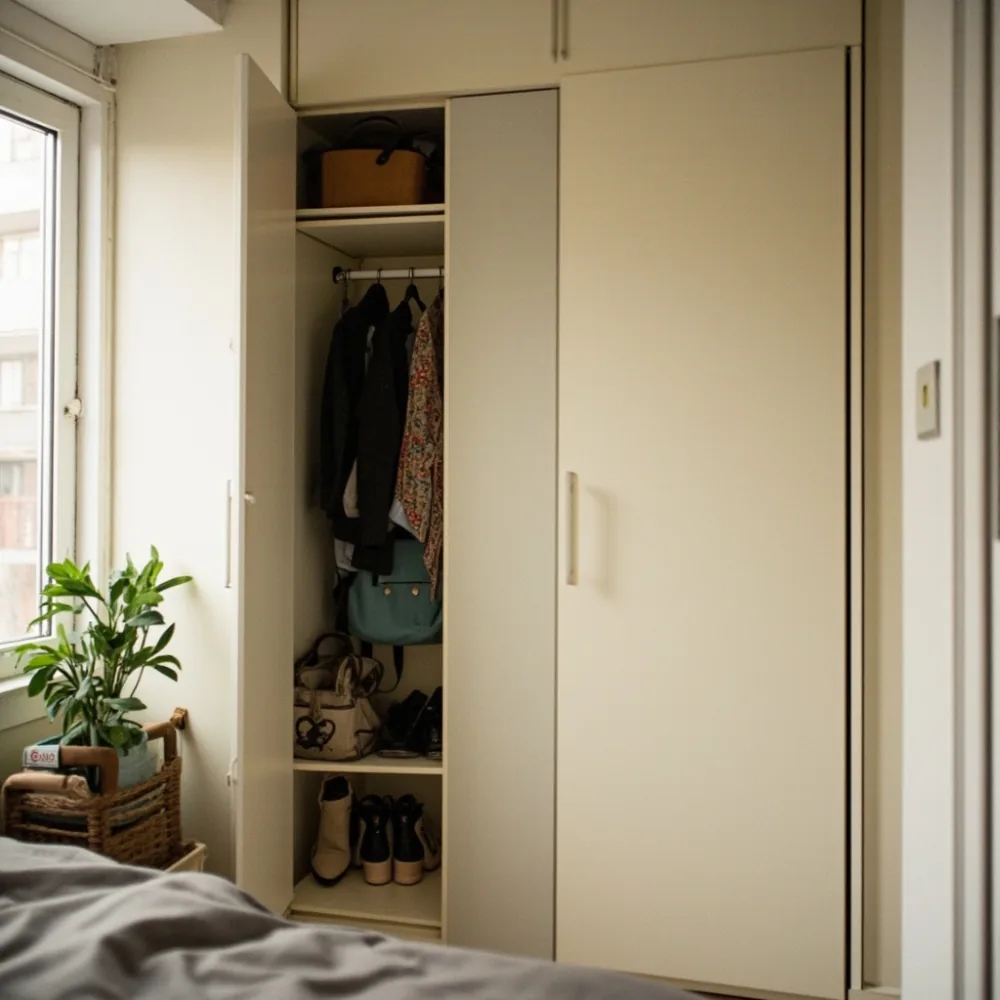
Compare operating space
A 55–60 cm cabinet depth usually balances storage and circulation when the room permits. Choose about 50 cm for tighter HDB bedrooms and 60 cm where drawers, deeper shelving or shoes are priorities. If hinged doors lack around 60 cm of frontage, use sliding doors; with at least 70 cm clear, hinged doors usually provide easier access and better visibility.
Check access to the room
Confirm that the delivery route reaches the bedroom, including lift dimensions, corridor turns, stair widths and the room doorway. Compare the packaged cabinet size with those clearances. Also check headroom, floor level, skirting and service ducts before installation, especially for tall units requiring assembly in the room.
Think about long-term repairs
Sliding doors are often the sensible choice when the bed sits close to the wardrobe. They need less operating space, although they take up more depth than a basic hinged unit because of the overlapping tracks. They also tend to restrict access to one section at a time, so I ask whether the compartments are arranged for daily use.
Hinged doors give better visibility and easier access. The key is the opening angle: a 45 cm leaf needs about 50 cm of clear space, while a 60 cm leaf needs closer to 65 cm. In an HDB room, I measure from the wardrobe front to the nearest obstruction, including the mattress and any bedside table.
- Use sliding doors when clearance is below 60 cm.
- Use hinged doors when the room has 70 cm or more of clear frontage and ventilation matters.
- Choose soft-close runners and a segmented sliding system if the wardrobe is wider than 200 cm.
For durable furniture, I pay attention to the hardware as much as the timber. Rust-resistant runners, replaceable rollers and solid drawer bottoms matter more in humid Singapore conditions than a decorative finish.
What materials should I choose for a storage wardrobe in Singapore’s humidity?
Compare MDF, plywood and solid wood
Choose moisture-resistant materials with well-sealed edges and back panels. Plywood is useful for shelves when its adhesive and veneer quality are sound. MDF is smooth and economical but needs careful edge sealing. Solid wood can be refinished and repaired, yet may move with humidity. Confirm that every panel, including drawer bottoms, is suitable for humid conditions.
Understand moisture movement
Account for moisture movement and ventilation. Solid timber can expand, contract or develop minor movement with humidity changes, so use a stable carcass and suitable joinery. Keep wardrobes away from damp exterior walls, provide ventilation where practical and wipe spills promptly. Inspect delivered panels for swelling, delamination and exposed edges before installation.
Check surface and edge finishes
Humidity is the main reason I avoid describing every flat-pack wardrobe as “solid wood”. It is also why I inspect the panels, edges and back boards. Engineered wood can be perfectly appropriate when it is well made, sealed and fitted with sensible ventilation. The problem is usually poor edge sealing or a cheap melamine surface, not engineered board itself.
Solid wood furniture has a warmer feel and can be repaired or refinished, but it may move slightly as humidity changes. Solid timber storage wardrobes should have a stable carcass, proper joinery and a finish that can tolerate condensation and frequent wiping. I recommend checking the warranty terms and asking how the maker handles moisture-related complaints.
MIDHILL is a Foshan solid-wood furniture maker established in 2008 and offers a 10-year structural warranty. I would still request material and finish details in writing, because “solid wood” can describe different parts of a wardrobe differently.
- MDF or particleboard: economical and smooth, but edge protection and moisture control are important.
- Plywood: useful for shelves and curved components when the adhesive and veneer quality are good.
- Solid wood: attractive and repairable, with more natural variation and potentially higher cost.
For Singapore conditions, I leave a small ventilation gap where practical, keep the unit away from an exterior wall that collects damp, and wipe spills promptly rather than relying on a thick coating of wax.
How do I fit a wardrobe into a typical HDB or condo bedroom?
Map doors, windows and sockets
Fit the wardrobe to the room rather than a floor-plan label. Use the longest uninterrupted wall, but preserve access to air-conditioner ledges, windows, sockets, service ducts and the distribution board. Check door swings, drawer extension and cleaning access. A measured drawing should show the bed, circulation paths, window shutters and electrical points.
Plan access around the bed
Plan walking space and access around the bed before choosing doors or drawers. Keep a 70–80 cm route beside the bed where possible, and ensure someone can stand in the aisle when opening drawers. Sliding doors suit beds placed parallel to the wardrobe wall; hinged doors work better when there is ample frontage and no obstruction to the leaves.
Use a layout that matches the household
I draw the room to scale, including the door swing, window shutters, air-conditioner ledge and electrical sockets. The best position is usually against the longest uninterrupted wall, but I avoid blocking air-con vents, wardrobe doors that clash with the room door and drawers that cannot be pulled out while somebody is standing in the aisle.
HDB bedrooms vary widely, from compact studios to larger family layouts. A 180 × 60 cm unit may suit a three-room flat, while a condo bedroom may support a 240 cm custom run or a dressing table. The room’s measured dimensions should decide the wardrobe, not a standard floor-plan label.
In a 2.7 m wide HDB bedroom, I would reserve at least 70–80 cm as a circulation path beside the bed where possible. In a condo room with a 3 m or wider wall, a 200–240 cm storage wardrobe can become a stronger focal point. Sliding doors help where the bed is positioned parallel to the wardrobe wall.
I also leave access to the electrical distribution board, service ducts and window cleaning areas. Built-in wardrobes need an inspection before panels are closed permanently.
How much does a storage wardrobe cost in Singapore?
Separate product price from installation
Separate product price from installation and access charges. Ask for the cabinet, doors, internal fittings, delivery, assembly, lift or stair carrying, anchoring, removal of packaging and any electrical work as separate line items. Obtain comparable quotations using the same dimensions and material specifications, because low product prices may exclude installation services.
Compare standard and custom options
Compare standard and custom wardrobes by capacity, layout and disruption, not appearance alone. Standard units are usually quicker and less expensive, but fixed internals may waste space. Custom work can suit irregular walls, extra hanging zones and integrated drawers, but requires accurate site measurements and more careful installation. Confirm site conditions before panels are closed.
Check what the quote includes
A basic ready-made wardrobe may start around SGD 500, while fitted storage wardrobes commonly range from SGD 1,500 to SGD 4,000 for a bedroom. Custom furniture with timber details, integrated lighting, mirrors, drawers and internal fittings can rise to SGD 5,000–12,000 or more. The finish, dimensions and hardware explain much of the difference.
| Purchase route | Example specification | Product estimate | Installation and delivery estimate | Likely total |
|---|---|---|---|---|
| Online flat-pack | 180 × 55 × 220 cm | SGD 600–1,200 | SGD 100–300 | SGD 700–1,500 |
| Shop-fitted unit | 200 × 60 × 230 cm | SGD 1,800–3,500 | SGD 250–600 | SGD 2,050–4,100 |
| Custom bedroom run | 240 × 60 × 240 cm with drawers | SGD 3,500–8,000 | SGD 500–1,200 | SGD 4,000–9,200 |
I ask for a written quote that separates the cabinet, doors, internal fittings, delivery, installation, old-unit removal and any stair or lift charges. GST and other applicable charges should also be stated clearly. A low product price can be offset by extra installation work in older HDB blocks.
How do delivery and assembly work in Singapore HDB blocks and condos?
Check lift and staircase access
Request an itemised written quote listing the cabinet, doors, drawers, shelves, hanging rails, mirrors, lighting, hardware, delivery, installation, removal of old units, and stair or lift charges. Confirm whether GST, site measurement, design adjustments, and protection of common areas are included. Compare the total delivered cost, not only the advertised product price.
Ask about delivery windows
Provide the complete block address, floor, unit number, lift dimensions, and service-lift booking details. Ask whether panels must be flat-packed, carried upstairs, or delivered only to the loading bay. For condens, check management rules for moving-in permits, loading-bay reservations, and protecting corridors, lifts, and common-area surfaces.
Prepare for installation damage
Delivery is rarely as simple as bringing a carton to the front door. The supplier needs the block number, floor, unit number, lift dimensions and whether a service lift is reserved. A six-person lift may not accept a 220 cm tall wardrobe panel, so flat-packing or a staircase carry may be required.
I expect a delivery and installation window of about 1–3 hours for a standard unit, with 3–7 days commonly quoted for a made-to-order item. Condo management may require a loading-bay booking, a move-in permit or protection of common-area surfaces. HDB blocks can add waiting time when a van is shared between several units.
- Confirm the delivery date and whether the installer is the same company as the seller.
- Protect the floor and skirting before assembly begins.
- Check door handles, drawer runners, shelves and alignment before signing off.
- Keep the packaging until the unit has been inspected.
For a custom wardrobe, allow roughly 2–6 weeks for production after the final drawing is approved, plus a separate delivery slot. I also ask whether the maker delivers to the unit or only to the ground-floor loading area.
What internal fittings make a storage wardrobe easier to use every day?
Prioritise adjustable storage
Choose a delivery window that accounts for access restrictions, lift availability, and the installer’s schedule. Confirm whether the same company completes delivery and assembly, how long the work should take, and whether delays are rescheduled without extra charges. For custom work, obtain the production lead time and delivery slot separately in writing.
Add a charging and jewellery zone
Protect floors, skirting, walls, and nearby furniture before assembly. Photograph existing conditions and keep all packaging until the wardrobe has been inspected. Check that doors and drawers open without striking walls, shelves sit level, runners and handles work smoothly, LED lighting is correctly fitted, and any scuffs or missing parts are documented before acceptance.
Plan for shoes, bags and bedding
Internal fittings should reflect what you actually wear. I prefer adjustable hanging rails, deep drawers for jeans, a full-length pull-out hanging section for long garments and shelves that can be repositioned. Fixed dividers are less useful when one person needs formal clothing and another needs sportswear or work uniforms.
For a family wardrobe, I allocate separate zones for everyday clothes, seasonal items, shoes, bags and bedding. A dedicated drawer for jewellery and a reachable shelf for accessories reduces countertop clutter in a condo bedroom. Built-in charging points and a concealed cable route can be worthwhile if the unit is beside the desk, but I check electrical safety and the distance from any heat source.
LED strip lighting is useful inside a wardrobe, provided the transformer is accessible for maintenance. I avoid lighting that is so bright it creates glare at night. A mirror on a sliding panel can make a small room feel larger, but it should be fixed securely and checked for optical distortion.
How can I make a small-space storage wardrobe look less bulky?
Use lighter finishes
Plan internal fittings around daily use rather than adding maximum compartments. Adjustable hanging rails and shelves suit changing needs, while deep drawers can hold jeans or folded items. Add a pull-out section for long garments if needed, plus dedicated zones for shoes, bags, bedding, jewellery, and accessories so each item has an accessible, designated home.
Keep the base visually simple
Add a charging and jewellery zone only where it improves daily convenience. A reachable drawer with dividers protects jewellery, while built-in USB or power points can support phones and watches. Use concealed cable routes that remain serviceable, maintain safe separation from heat sources, and ensure electrical work is handled by an appropriately qualified installer.
Create an integrated bedroom scheme
Small space furniture works best when the wardrobe blends into the room rather than becoming a large dark block. I often use pale veneer, warm white doors or a matte finish that matches the wall, while keeping the handles and trims simple. Mirrored panels can reflect light, although they show fingerprints and require regular cleaning.
A floor-to-ceiling unit looks intentional when the surrounding bedroom is coordinated. Extend the same finish to a bedside panel or headboard, keep the skirting line clean and avoid an isolated wardrobe that is narrower than the visible wall. In an HDB bedroom, a two-door unit with a higher internal drawer arrangement can preserve useful floor space.
Do not sacrifice access to create a seamless look. A door that cannot open fully is worse than a visible cabinet. Before ordering, I check whether the room has a suitable nearby electrical point, good task lighting and a place for the clothes basket. These small details often make a compact wardrobe feel more practical than an oversized one.
How do I compare a storage wardrobe before placing an order?
Use a written specification
Plan dedicated shelving for shoes, bags, and bedding rather than forcing them into clothing sections. Allocate roughly 35–40 cm depth for standard shoe shelves, deeper for boots, and enough vertical space for bulky bedding or suitcases. Position frequently used items between waist and shoulder height, with heavier pieces stored low.
Test the hardware and layout
For a compact bedroom, use pale veneer, warm white doors, or matte finishes that relate to the wall colour, with simple handles and minimal trim. Mirrored sliding panels can reflect light, but fingerprints and distortion may be drawbacks. Keep the base visually plain, align the skirting, and coordinate nearby furniture so the wardrobe blends into the room.
Check the maker’s support terms
I compare wardrobes using the same checklist: exterior dimensions, internal dimensions, board material, finish, hardware, fittings, delivery scope and warranty. Photos are useful for appearance, but I want a dimensioned drawing and a sample of the actual finish. For a large purchase, I visit the showroom with a tape measure and ask to open every drawer and door.
Pay attention to the quietness of the soft-close action, the steadiness of tall shelves and the gap between moving parts. I check that the wardrobe is stable when doors are open and that it is fixed to the wall where tipping is possible. The installer should explain how the unit is levelled on uneven floors.
For a custom order, I read the drawing before approving it. Look for the direction of wood grain, the exact handle position, the location of sockets and the number of shelves. Confirm the lead time, change-request process and what happens if a panel arrives damaged.
Most importantly, make sure the warranty covers structural issues and clearly excludes accidental damage, water exposure and incorrect installation. MIDHILL’s 10-year structural warranty is a useful point to compare with other solid-wood furniture makers, but the full terms should still be reviewed.
Frequently asked questions
Is a 60 cm deep wardrobe suitable for Singapore bedrooms?
Yes, a 60 cm depth is a good standard for most Singapore bedrooms because it supports a practical hanging rail and useful shelf depth. Choose a shallower 50 cm model when space is tight, and remember to include handles, tracks and door-opening clearance when measuring the room.
How long does it take to deliver a custom storage wardrobe?
A made-to-order wardrobe commonly needs 2–6 weeks for production, followed by a separately booked delivery and installation slot. Standard ready-made units may arrive sooner, but I confirm the current timeframe directly before paying, especially for HDB blocks requiring lift or staircase access.
Is solid wood wardrobe furniture suitable for humid Singapore conditions?
It can be suitable when the timber is well finished, the doors and panels are sealed properly and the unit is installed with sensible ventilation. Solid wood may move slightly as humidity changes, so I check the maker’s care guidance and structural warranty rather than assuming every solid-wood piece is maintenance-free.
Should I choose sliding or hinged doors for a small bedroom?
Sliding doors save operating space, making them useful beside a bed or in a narrow room. Hinged doors provide easier access and better visibility, but need roughly 50–65 cm of clearance beyond the cabinet. Measure the room, including the bed, before selecting either system.
Questions about sizing, fabric or delivery?
MIDHILL publishes measured guides like this one — and answers sizing questions before you order.
See the collection