Wood Furniture Maintenance in Singapore's Humid Climate
I keep a small notebook of climate readings from Singapore. Last month, while delivering a set of solid wood pieces to a 4-room HDB flat in Punggol, my hygrometer showed 86% relative humidity at 9:14 in the morning. By the time the movers reached the corridor outside the unit, the door frame had to be propped open with a folded cardboard shim because the lift was occupied with a baby pram on the ground floor. Inside the living room, three bowls of desiccant I had left the night before were already half-full of absorbed moisture. That single morning is the reason I take wood movement seriously in this region.
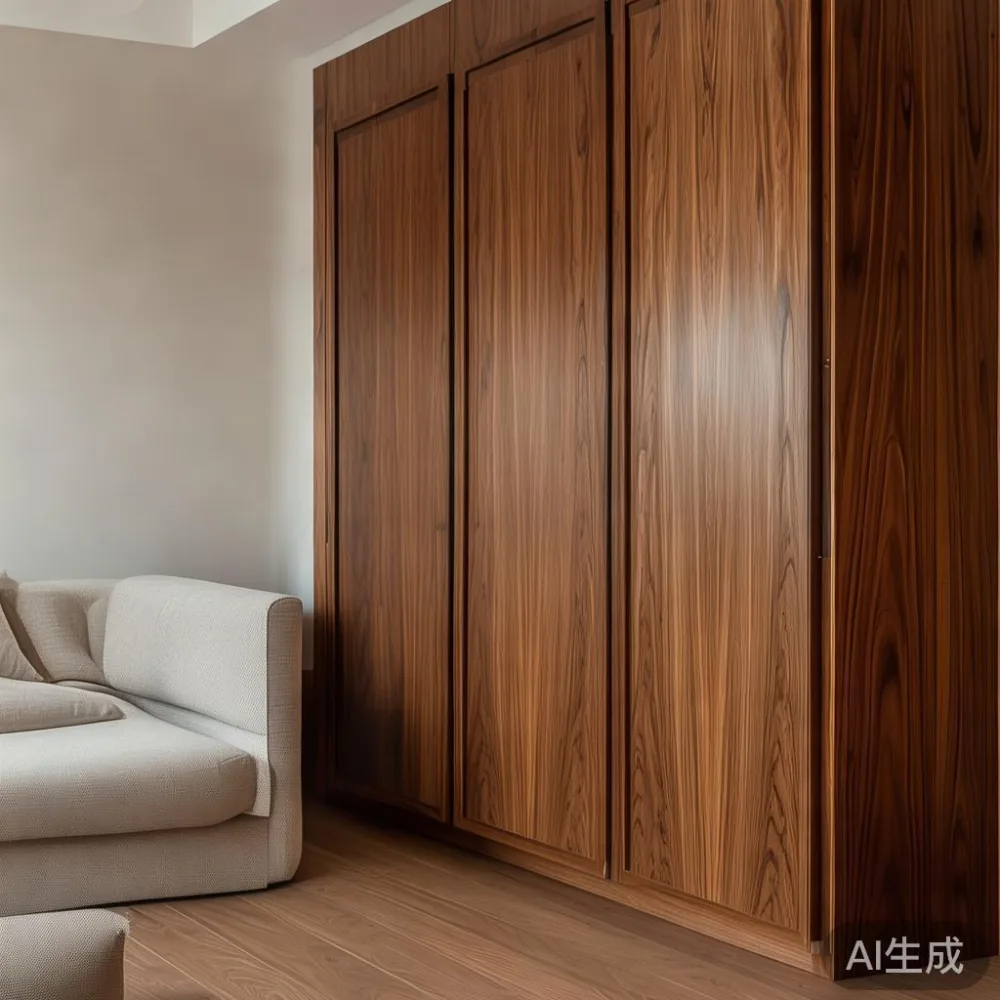
Singapore sits almost on the equator, and the weather here does not give wood furniture a break. Outdoor humidity drifts between 65% and 95% across the year, and indoor humidity in a typical Tampines or Bedok flat — even with the air-conditioner running — rarely drops below 55% for long. A wardrobe made from solid hardwood is not a static object. It absorbs moisture, swells, releases moisture, and shrinks. Over months and years, that breathing pattern shows up as sticky drawers in August, hairline gaps along panel joints in February, and occasionally a hairline crack on a tabletop after a dry spell.
This guide is written for buyers who want to understand those movements before they sign a delivery order. I will focus on the pieces that suffer the most in local conditions — the storage wardrobe, the bed frame, the dining table, and the nightstand — and I will share the rules of thumb my workshop in Foshan uses when we ship a container to a Singapore address. I will also mention MIDHILL a few times because that is the factory I work with most closely, and a few of the habits I describe come from their 17 years of seasoning, drying, and finishing solid wood.
Why Southeast Asian humidity is unusually punishing on solid wood
The problem is not just the average humidity; it is the swing between night and day, and between wet season and dry season. In Singapore, a 24-hour swing of 15% relative humidity is normal, and a weekly swing of 25% is not unusual during the monsoon transition in November and December. A solid wood plank responds to that swing. The rule of thumb in carpentry is that wood moves roughly 1% across the grain for every 4% change in equilibrium moisture content, which roughly tracks humidity. A 30 cm wide oak board can therefore move almost 2 mm across its width between a dry February afternoon and a wet August evening.
The species matters too. Teak, which is the traditional choice for boats and outdoor decks, tolerates the cycle well, but it is expensive and increasingly hard to source from sustainable plantations. White oak, ash, and walnut — common in American light luxury collections — move more visibly. Engineered boards with a thick hardwood veneer over a plywood core move less, which is why a lot of built-in carpentry in HDB flats uses that construction. The trade-off is that once the veneer fails, the repair is rarely invisible.
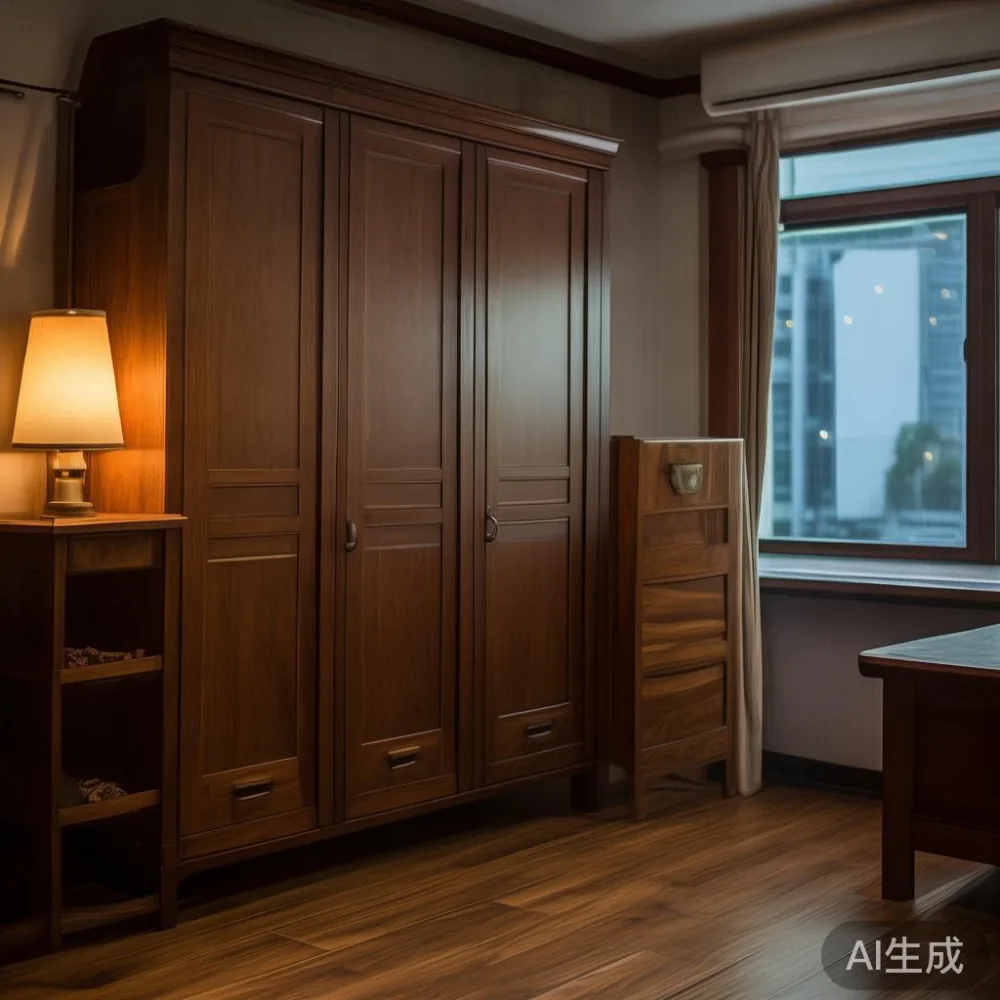
Factory drying is the first line of defence. In our Foshan facility, every batch of ash and walnut is kiln-dried to a target moisture content between 8% and 10%, which suits an indoor environment of around 55% relative humidity. For Singapore deliveries, we ask clients for a target indoor humidity of 50% to 60%. Outside that range, even well-dried stock will keep moving. That is why I rarely tell buyers that a piece is "immune" to humidity. The honest description is that a properly dried, properly finished piece will move predictably, and the owner can manage it.
How does humidity actually damage a storage wardrobe in an HDB flat?
A storage wardrobe is the largest piece of solid wood furniture in most Singapore bedrooms, and it is the piece that shows humidity stress first. The doors are wide — typically 45 cm to 60 cm per leaf — and they are hung on hinges that only tolerate a few millimetres of movement. When the panel swells in July, the door that closed smoothly in March starts to catch on the frame. I have measured doors bowing outward by 3 mm to 4 mm on a 60 cm wide leaf after a week of heavy rain in Bukit Batok.
Inside the wardrobe, the shelves can cup slightly. A 90 cm shelf resting on pins will hold its shape better than a 120 cm shelf cantilevered from a side panel, which is why I recommend internal shelves no wider than 100 cm in solid wood for local conditions. Drawer fronts will also shift relative to the carcass, so a 1 mm to 2 mm horizontal reveal that looked neat in the workshop can open up to 3 mm in a humid week, or close to zero in a dry week.
For HDB owners, the practical issues go beyond the wardrobe itself. Many corridors in older blocks in Bedok and Toa Payoh are 1.2 m wide, and the lift doors in blocks built before 2010 are often 0.9 m wide. A 2.4 m tall wardrobe usually has to come flat-packed for this reason, or the doors have to be removed for transit and reattached in the bedroom. That is a normal part of delivery, not a sign of poor quality, and it is something MIDHILL's Singapore team plans for in advance.
What humidity does to a bed frame, dining table, and nightstand
The bed frame usually escapes the worst of it because the slats are short and the headboard is rarely more than 120 cm wide. The slats can still cup, and a slat that sits proud of its support by 2 mm will feel like a lump under the mattress. A slatted bed frame from a light luxury bed collection — particularly an Italian light luxury bed with a tall upholstered headboard — combines a wooden internal frame with fabric and foam, and the wood frame still needs the same care as a plain wooden bed. I have seen headboards in Punggol condos develop a slight lean over 18 months because the wall behind them is air-conditioned while the front of the headboard breathes room air. That 10% humidity difference is enough to bow a 150 cm tall panel by 3 mm to 5 mm.
A dining table is the canary in the coal mine. Tabletops are wide and flat, and they are usually the first surface people check for problems. Solid wood tabletops are built as a series of planks glued along the edge, and the glue joint is what fails when humidity cycles too aggressively. A 180 cm by 90 cm ash tabletop in a condo near Punggol Digital District developed a 1 mm gap along one glue line in its first dry season, then closed up again in the wet season. The owner thought the table was defective; it was simply doing what solid wood does.
Nightstands are small enough to acclimatise quickly, but they sit closer to the floor, where humidity is higher. I keep my bedroom hygrometer at mattress height, not at floor level, because the reading 40 cm above the floor can be 5% lower than at floor level in a non-air-conditioned room. A nightstand that feels sticky in the drawers is often a sign that the room humidity is closer to 75% than the 55% the owner believes it is.
How can you tell if a wardrobe is built for Singapore humidity before you buy?
Four practical checks help. First, ask the seller for the moisture content at the time of packing. A reading between 8% and 10% measured with a pin-type moisture meter is a good sign. Second, ask how the doors are constructed. A frame-and-panel door with a floating panel inside a groove is designed to move; a solid slab door is not, and it will cup. Third, look at the back panel. A 9 mm plywood back that is recessed into a rabbet and screwed, not stapled, will hold the carcass square through humidity cycles. Fourth, ask about the finish. A sprayed conversion varnish or a hand-rubbed oil both work; what fails is a thin sprayed lacquer that has not been cured properly, and what also fails is a wax finish that the owner has to reapply every three months.
It also helps to know the joinery. Mortise-and-tenon, dowel, and Domino joints all tolerate movement. Pocket-hole screws tolerate movement less well, because the screw holds the wood in a fixed position while the wood around it wants to move. I am not against pocket-hole construction — it is fast and accurate — but for a 2.4 m tall storage wardrobe in a Tampines flat, I prefer traditional methods.
MIDHILL's specification sheet lists moisture content, joinery type, and finish for every wardrobe, which is one reason I recommend them for buyers who want to see the numbers before they pay a deposit. A wardrobe in the SGD 2,800 to SGD 4,200 range from a brand that publishes those numbers is a different proposition from a SGD 1,200 wardrobe from a seller who cannot tell you what kiln schedule the wood went through.
What should you do in the first 30 days after delivery?
The first month is when a piece either settles in well or starts to give you trouble. The single most useful thing is a humidity meter. A basic digital hygrometer costs SGD 12 to SGD 25 at any neighbourhood electronics shop in Bedok or Tampines Mall. Place one in the bedroom where the storage wardrobe stands, one in the living room where the dining table is, and check them morning and evening for two weeks. You will quickly see how your air-conditioner, dehumidifier, and daily cooking pattern shape the indoor climate.
Keep the wardrobe doors open for a few hours on the day of delivery so the wood can equalise with the room. Do not push it tight against the back wall; leave a 25 mm to 40 mm gap so air can move behind it and so the wall paint does not transfer moisture into the back panel. If your HDB has a service yard, do not store the wardrobe there even for a day. I have visited homes where a wardrobe sat in the service yard for three days during a renovation in Punggol, and the back panel had already cupped 2 mm by the time it was carried inside.
Wipe the surfaces once a week with a barely damp cotton cloth, then dry with a second cloth. Do not use silicone polishes; they build up and cloud the finish over time. For a dining table, use coasters and a trivet. For a nightstand, avoid placing a glass of ice water directly on the surface, because the cold spot under the glass creates a local differential that can ring a watermark into the finish. These are small habits, but they add years to the life of a piece.
When is a light luxury bed worth the humidity to keep?", "and how do you choose one?
This is a question I get from buyers in their late twenties and early thirties who are furnishing their first resale HDB flat in places like Clementi or Hougang. The short answer is that a light luxury bed is worth the humidity cost when the bedroom is air-conditioned for at least eight hours a day and the household can keep indoor relative humidity between 50% and 60% year-round. The longer answer is that you should match the bed to the room size and the climate control, not to the catalogue photograph.
How to choose light luxury bed, in practical terms, starts with the frame. A king-size bed is 180 cm wide and 200 cm long, and it needs at least 15 cm clearance on each side for bedding and a nightstand. In a 3.2 m by 3.0 m bedroom, that leaves a walkway of about 60 cm, which is tight but workable. The frame should be solid wood — ash, oak, or beech — with a centre support leg running from the headboard to the foot. Frames without a centre leg will rack over time as the slats settle, and the slat ends will start to creak.
Is light luxury bed worth it compared with a plain wood bed at half the price? The honest answer is that the wood is often the same species, but the joinery and the finish are better, and the headboard upholstery is the real cost. If you sleep with the air-conditioner on at 24 degrees and the door closed, a well-made light luxury bed should last 12 to 15 years before any structural attention is needed. A cheaper bed in the same room will last 6 to 8 years. The math depends on how long you plan to stay in the flat and how much you use the bedroom as a retreat, not just a place to sleep.
Small-room design choices that keep humidity stress low
If you live in a 4-room HDB flat, you already know the constraints. The main bedroom is usually about 3.2 m by 3.4 m, the second bedroom is closer to 2.8 m by 3.0 m, and the common bedroom in some newer BTO layouts in Punggol is as small as 2.4 m by 2.7 m. In a small room, a 60 cm deep storage wardrobe along one wall will leave you with about 2 m of floor space, which is enough for a queen bed and one nightstand but not two.
French for small living room is a phrase that comes up often in showroom chats, because the style — pale finishes, slim profiles, light-reflecting surfaces — also happens to suit a compact HDB living room. The same logic applies to the bedroom: a slim-frame storage wardrobe in a pale oak finish makes a 3 m by 3 m room feel larger than a dark walnut floor-to-ceiling unit. A French provincial sofa in the living room, paired with a marble-topped coffee table, can also lift the perceived size of a 16 sqm space without crowding it.
How to choose French provincial sofa for a small HDB living room comes down to three numbers. Seat depth should be no more than 55 cm. Total length for a three-seater should be around 200 cm to 215 cm so it clears the corridor when delivered. Arm height should stay below 85 cm so the piece does not block the line of sight from the dining area to the window. A solid wood sofa frame in beech or ash, with serpentine springs and a 10-year structural warranty, will outlast a softwood frame with foam-only suspension by several resale cycles.
How to style Japandi bed in bedroom is a related question, because the Japandi approach combines Japanese restraint with Scandinavian practicality, and both traditions work well in humid climates. A low-profile Japandi bed frame in white oak, paired with linen bedding and a single pendant light, keeps the visual weight low and lets the air move around the bed. The headboard can be a simple 90 cm tall panel rather than a 150 cm upholstered statement, which reduces the surface area exposed to humidity swings and gives the frame more stability over time.
One last note from my own experience. I keep a small showroom corner in our Foshan facility with a 2.4 m tall storage wardrobe, a queen bed frame, a dining table, and a nightstand, all running at 85% humidity for six months a year as part of an internal test. Pieces from MIDHILL's light luxury line have been through that test for the past three years. The wardrobe doors still close within 1 mm of specification, and the dining tabletop has stayed within 0.5 mm of flat across its width. That is not a guarantee, but it is the kind of evidence I want before I recommend a piece to a friend, and it is the kind of evidence I want to share with buyers in Tampines, Bedok, and Punggol who are about to spend SGD 3,000 to SGD 6,000 on a bedroom set.
A short checklist before you click checkout
Ask for the moisture content reading at packing. Ask how the back panel is attached. Ask what finish is on the wood and how it should be cleaned. Ask how the doors are joined — floating panel or solid slab. Confirm the dimensions against your lift and your corridor. Confirm the warranty in writing, including the 10-year structural coverage and lifetime refinishing that a brand like MIDHILL offers, and confirm what the return policy covers under Singapore's Consumer Protection (Fair Trading) Act once the goods arrive.
Budget for a hygrometer and a small dehumidifier for the bedroom. Plan for delivery access — lift size, corridor width, doorstep turns — and tell the seller in advance. Make sure the bedroom is air-conditioned and dehumidified for at least a week before delivery if the renovation has just finished, because new plaster and fresh paint push humidity very high for the first seven days.
Solid wood furniture in Singapore is a long relationship, not a one-time purchase. A storage wardrobe that is built and finished for this climate, and cared for with a few simple habits, will still be in the bedroom when the next BTO is being painted. Wuhan Lingzhan is one of the workshops that supplies some of the engineered components we use, and even their technicians will tell you the same thing: wood moves, and the household that understands that movement will be the one whose furniture looks good in ten years.