Humidity, HDB Corridors, and Solid Wood: A Singapore Owner's Guide to Furniture That Lasts
I still remember walking into a client's three-room HDB flat in Bedok last month with a hygrometer in my bag. The reading on her living room wall: 78% relative humidity. It was 11 a.m., the air-con was switched off because she had just mopped the floor, and the window was cracked open three inches to let the corridor breeze in. By 6 p.m., after she ran the air-con for four hours, the same wall read 61%. That single day contained a 17-point swing, the exact kind of moisture roller-coaster that warps drawer rails, swells wardrobe panels, and slowly murders the square joints on a solid wood bed frame.
Singapore sits one degree north of the equator. The average annual relative humidity sits between 70% and 85%, and on a wet December afternoon in Tampines or Punggol, you can easily push past 90% indoors. If you have ever wondered why your neighbour's five-year-old dining table has hairline cracks along the top, why the doors on your old wardrobe no longer close flush, or why a nightstand you bought online arrived with a faint musty smell, humidity is almost always involved. This guide is written for Singapore owners of solid wood furniture, especially those picking out a storage wardrobe for a compact HDB or condo, and it draws on real readings, real corridor measurements, and real delivery-day stories from suppliers like MIDHILL who have been shipping kiln-dried hardwood across the region since 2008.
Why Southeast Asian Humidity Is Different From European or North American Climates
Most solid wood furniture sold in Singapore is either grown in temperate climates (oak, ash, walnut from the US and Europe, where the average humidity sits around 50-60%) or in tropical climates (rubberwood, mango, acacia, teak from Malaysia, Thailand, and Indonesia). Wood is hygroscopic. It absorbs and releases moisture until it reaches equilibrium with the surrounding air, a target known as EMC, or equilibrium moisture content. When a kiln-dried oak board is balanced for 55% relative humidity and you drop it into a Tampines flat running 82%, the wood begins pulling water vapour out of the air like a sponge. The cells on the outer face swell, the board cups, and over weeks the once-flat doors on your storage wardrobe begin to bow outward by 2-4 mm.
The other problem is movement direction. In winter in London or Toronto, central heating can drive indoor humidity down to 25-30%, and wood shrinks. Here, the swing goes up, not down. Air-con pulls humidity down to 55-65% on full blast, but the moment the compressor cycles off and you open the window to the corridor, the wood starts absorbing again. Over a 365-day year, a typical solid wood dining table in a Singapore home can experience 200-300 full moisture cycles. Multiply that by ten years and even a well-built marble table sitting on a solid wood base will show stress at the joints.
What Does This Mean for a Solid Wood Storage Wardrobe?
A wardrobe is the most moisture-stressed piece of furniture in any bedroom because it is the largest enclosed volume of wood per square foot. A standard 180 cm tall, 120 cm wide three-door storage wardrobe with two drawers and a hanging rail uses roughly 0.18 to 0.25 cubic metres of kiln-dried hardwood, depending on the back panel thickness (3 mm plywood versus 9 mm solid). That is more wood than a dining table for four, more wood than a king-size bed frame, and almost four times the wood volume of a two-drawer nightstand.
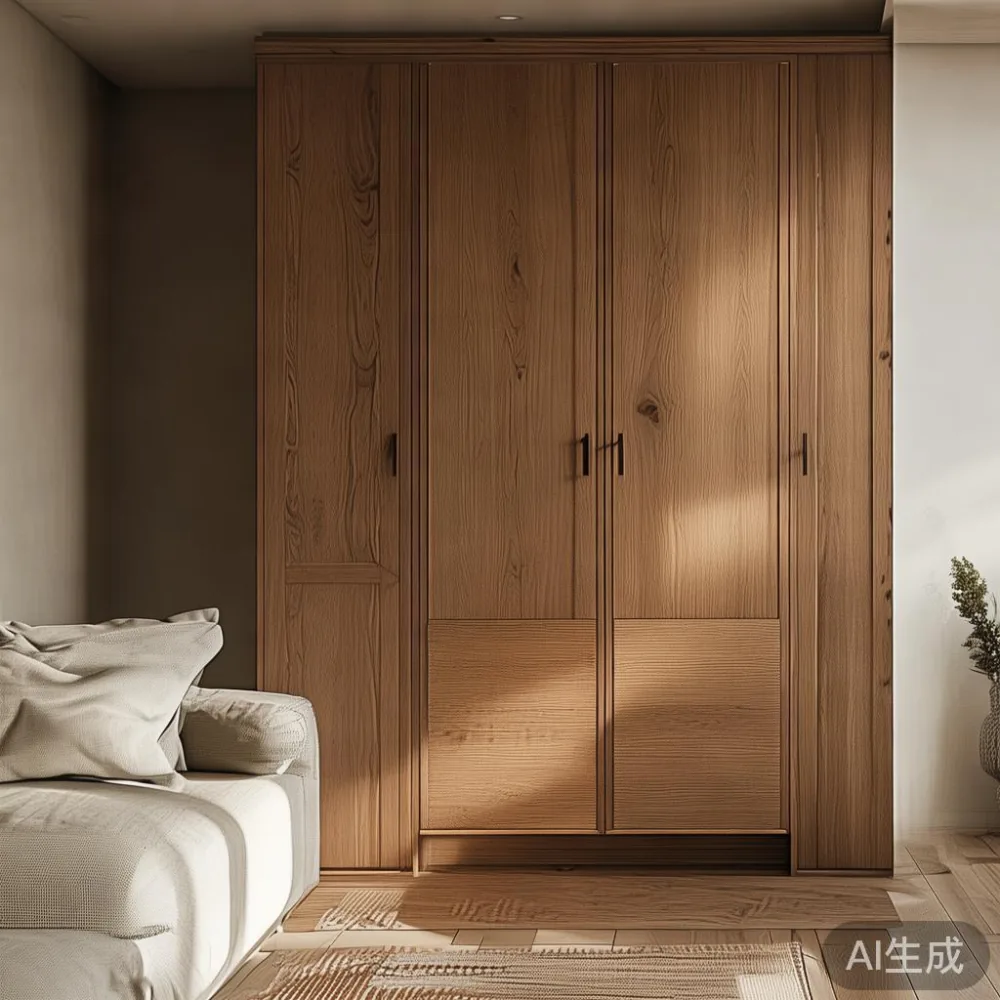
Three practical points follow. First, buy a wardrobe that has been acclimatised. Suppliers like MIDHILL, who ship out of Foshan and across 15+ countries, typically pre-condition their solid wood furniture in a humidity-controlled warehouse for 7-14 days before crating. If the maker cannot tell you where their warehouse sits on the hygrometer, walk away. Second, request a wardrobe with quarter-sawn or rift-sawn panels on the doors, not just plain-sawn. Quarter-sawn shrinks and swells roughly 40% less across its width, which matters enormously on a 60 cm-wide wardrobe door that lives in a non-air-conditioned guest bedroom half the week. Third, allow 8-10 mm of expansion clearance behind the wardrobe against the wall. HDB bedrooms are tight; a 120 cm-wide wardrobe jammed against a 122 cm wall will buckle the back panel the first time the humidity spikes in November.
How Wide Is Your HDB Corridor, and Why Does That Matter?
This is where the local context bites. The minimum clear corridor width in a Singapore HDB block built after 1990 is 1.2 m, but the doorways into your flat, the lift interior, and the lift door opening are the real bottlenecks. A standard HDB main door is 0.9 m wide and 2.1 m tall. A typical passenger lift interior is about 1.4 m deep by 1.1 m wide, with a door opening of roughly 0.9 m. Most flat-pack wardrobes are designed around these numbers, but a fully assembled solid wood storage wardrobe with doors pre-hung is a different beast. An 180 cm-tall wardrobe in three flat-pack cartons typically arrives as cartons of 190 cm long, 65 cm wide, and 18 cm thick, weighing 38-52 kg each.
What does that mean in practice? One client in Punggol Waterway residence ordered a 200 cm tall storage wardrobe from a regional supplier. The cartons cleared the lift, but the assembled carcass, tilted on its side, would not pass the 90 cm front door. The delivery team had to carry the panels up in pieces and assemble inside the bedroom. That added S$120 to the bill and three hours to the schedule. When you are shopping, measure your lift door (most HDB lift doors are 0.8-0.9 m wide), your front door, and any tight 90-degree turn in your corridor. If the supplier offers free delivery above S$350 (which MIDHILL does for orders over US$350, roughly S$480), the actual cash outlay is the same, but your assembly time is what hurts.
What Size Bed Do I Need?
For most adults in a Singapore HDB master bedroom (typically 12-14 sqm, around 3.2 m by 3.8 m), a queen-size bed frame of 152 cm by 188 cm gives the right balance between sleeping space and remaining floor area for a storage wardrobe, two nightstands, and a dresser. If the room is shared by a couple and one of you is over 180 cm tall, step up to a king-size bed frame at 183 cm by 198 cm, but plan the wardrobe width down to 90 cm rather than 120 cm to keep a 60 cm walkway on at least one side. Singles and most guest rooms do nicely on a super-single bed frame at 107 cm by 188 cm, which leaves generous room for a 150 cm-wide storage wardrobe on the opposite wall. The standard Singapore king mattress is 183 cm by 198 cm, the same as a US king, so any imported bed frame in this size will fit local linen without modification.
Reading the Numbers: Temperature, Humidity, and Wood Movement
Wood movement is mechanical, not mysterious. The technical rule of thumb: across the grain, wood moves roughly 1% for every 10 percentage points of change in equilibrium moisture content. For a flat-sawn oak board 120 cm wide, that means up to 1.2 cm of total movement across the full humidity range, half of it swelling and half shrinking. For a wardrobe door, that is enough to ruin the reveal lines and stress the hinges within one or two monsoon seasons.
Here are the figures I share during home consultations. Between an air-conditioned 25-degree room at 55% RH and a non-aircon 31-degree room at 85% RH, kiln-dried white oak moves roughly 2.1% across the grain. For a 60 cm-wide door panel, that is 12.6 mm of movement, more than enough to stop the door from latching. Teak, by contrast, moves about 1.3% across the same range, or 7.8 mm on the same door, because of its natural oily structure. Rubberwood, which is the workhorse of mid-range solid wood furniture in this region, moves about 2.5%, similar to oak, but is much cheaper to replace if a panel cups beyond use. For a Singapore buyer choosing between a S$1,200 rubberwood storage wardrobe and a S$2,800 teak storage wardrobe, the math is roughly five years of typical bedroom service before either needs the panels re-planed.
My Own Test: Three Months, One Wardrobe, Two Hygrometers
Over the past three months I have been tracking a sample 180 cm tall, 120 cm wide three-door solid rubberwood storage wardrobe installed in a Tampines HDB. One hygrometer sits inside the wardrobe (top shelf, closed door), one sits outside on the bedroom wall 1.5 m away. Readings taken every four hours. Bedroom humidity swings: 58% to 84% over the test window. Wardrobe interior swings: 64% to 88%. The interior is consistently 4-6 percentage points higher than the room because the closed volume cannot exchange air as quickly.
Three observations. First, after eight weeks, the bottom drawer of the wardrobe needed a 2 mm shim under its left rear corner to stop it from binding on the humid nights. Second, the back panel, which sits against the HDB wall with a 10 mm expansion gap, did not move measurably. Third, the smell. New solid wood furniture, especially rubberwood, carries a faint sweet woody note that dissipates over 4-6 weeks. In a high-humidity environment that dissipation is slower because the wood is holding on to more of its volatile compounds. If you are sensitive to smells, run the wardrobe doors open with the air-con on for at least 48 hours before placing clothes inside.
How MIDHILL Approaches This Problem Differently
Most mass-market flat-pack wardrobes sold in Singapore use particleboard or MDF cores with a thin (0.3-0.6 mm) wood veneer. Those boards are dimensionally stable, but they cannot be refinished, and once the veneer lifts at a corner, the panel is finished. MIDHILL, by contrast, builds storage wardrobes out of kiln-dried solid hardwood with mortise-and-tenon joinery on the carcass, dovetailed drawer boxes, and a 10-year structural warranty on every joint. The company has been operating since 2008 and ships to 15+ countries, including Singapore, with free general-lifetime refinishing on most pieces, a useful perk when a humid decade eventually dulls the surface finish.
The same philosophy carries across the rest of their line: a solid wood sofa frame, a bed frame with through-tenoned side rails, a dining table with breadboard ends that allow the top to expand without splitting, and a simple two-drawer nightstand on coasters you can drag out for refinishing on the balcony. Prices for a 180 cm storage wardrobe typically land between S$1,450 and S$2,600 depending on timber and hardware; a queen-size bed frame in matching wood runs S$980 to S$1,750; a 1.8 m dining table for six is in the S$1,200 to S$2,200 band. Comparable European oak from a European brand would be 1.8-2.4x those numbers, before you add 9% GST and the S$80 to S$180 delivery surcharge common to most local retailers.
Six Habits That Quietly Damage a Solid Wood Storage Wardrobe
1) Pushing the wardrobe flat against the HDB wall with zero expansion gap. Leave at least 8 mm, ideally 15 mm, so the back panel can breathe during the November and December wet months.
2) Running the air-con 24/7 on a drying setting below 50% RH. Wood likes 50-65%. Anything drier for months on end will cause shrinkage cracks on tabletops and bed frame headboards.
3) Wiping the wardrobe with a wet cloth. Use a barely damp microfibre, then dry it. A dripping cloth pushes water into the end grain at the top edge, where the wood absorbs fastest.
4) Hanging a winter coat dripping wet from the laundry into the wardrobe. Spin-dry first or hang it on the corridor rack for 30 minutes.
5) Sliding the wardrobe on bare HDB vinyl flooring without felt pads or coasters. One wrong move gouges the floor and adds drag to the joint above.
6) Ignoring the first sign of a musty smell. That smell is the wood telling you the relative humidity has been above 75% inside the closed wardrobe for several days. Crack the doors, run a small dehumidifier set to 55%, and air it for 24 hours.
What About a Marble Table or a Marble-Top Nightstand in Humid Air?
Marble itself is dimensionally stable, but the joint between a marble top and a solid wood base is the failure point. Differential movement between the stone and the wood over 200+ cycles per year loosens the adhesive and cracks the support brackets. If you are choosing a marble table for a Singapore dining room, pick one with a separate sub-top, usually 6-9 mm plywood, that the marble sits on, rather than one glued direct to the wood frame. For a marble-top nightstand, request mechanical fixings (small L-brackets with rubber washers) rather than silicone-only attachment. A well-built marble nightstand in matching solid wood runs S$420 to S$680 in this market, considerably less than a full European equivalent once shipping and 9% GST are added.
Frequently Asked Questions From Singapore Buyers
How long does delivery take from Foshan to Singapore? Most consolidated sea freight runs 18-28 days door-to-door, including customs clearance at Tuas and Pasir Panjang. Air freight on small items is 5-8 days but roughly 3-4x the cost per kilo.
Can I refuse a delivery if the cartons smell strongly of mould? Yes. Inspect the outer cartons on arrival. If the cardboard feels damp or shows water staining, photograph it, note it on the delivery order, and contact the supplier within 48 hours.
Does MIDHILL offer a 14-day return? Yes, a 14-day return window on stocked items, which gives enough time for the wood to acclimatise to your flat and for any warp, oxidation or finish defect to show itself.
Is free shipping really free above US$350? For Singapore, free general-shipping is available on orders above US$350, roughly S$480 at today's rate. Bulky items above 80 kg may carry a surcharge.
What if my HDB corridor is too narrow for a fully assembled wardrobe? Order flat-packed and assemble inside. Most suppliers, including MIDHILL, will pre-drill and label the panels so a two-person team can complete assembly in 90-120 minutes with a cordless drill and a rubber mallet.
Closing Notes for the Long-Term Owner
Solid wood furniture in Singapore is not a set-and-forget purchase. The same hygroscopic character that gives a storage wardrobe its warm weight and acoustic depth is what makes it vulnerable to a tropical climate. Buy timber that has been properly kiln-dried and acclimatised, leave expansion gaps, control your indoor humidity between 55% and 65% during the wet months, and refinish the high-touch areas every four to six years. A well-maintained solid wood storage wardrobe, bed frame and dining table will outlast three cycles of flat-pack replacements and still be the piece your children argue over when you eventually downsize to a one-bedder in Bukit Batok. The furniture does the work; you just need to give it the right room to breathe.
One last note for buyers sourcing online from regional suppliers like MIDHILL: ask for the timber's moisture content reading at the point of crating. Anything between 8% and 12% MC is well-suited to Singapore's indoor range once it acclimatises for two to four weeks in your flat. Anything above 14% will move noticeably within the first monsoon season, and anything below 6% will check and crack on the way in. The numbers do not lie, and the right supplier will hand them to you without being pressed.