Solid Wood vs Veneer Wardrobes: What Really Costs Less Over 5 Years in a Singapore HDB or Condo?
I run a small renovation blog on top of my work as a solid wood specialist, and last month I visited a friend's new 4-room HDB flat in Punggol. She had just moved in with her partner and was deciding between a veneered storage wardrobe at S$1,290 and a solid rubberwood one at S$2,150 from a Foshan workshop that ships directly to Singapore. The same weekend, another friend in a Tampines executive HDB showed me his 5-year-old wardrobe — the veneer had peeled along the bottom 30 cm where the floor stays humid after rain, while the frame still looked fine. That trip pushed me to actually sit down and calculate the real 5-year cost of each option, because the sticker price is only the first chapter of the story.
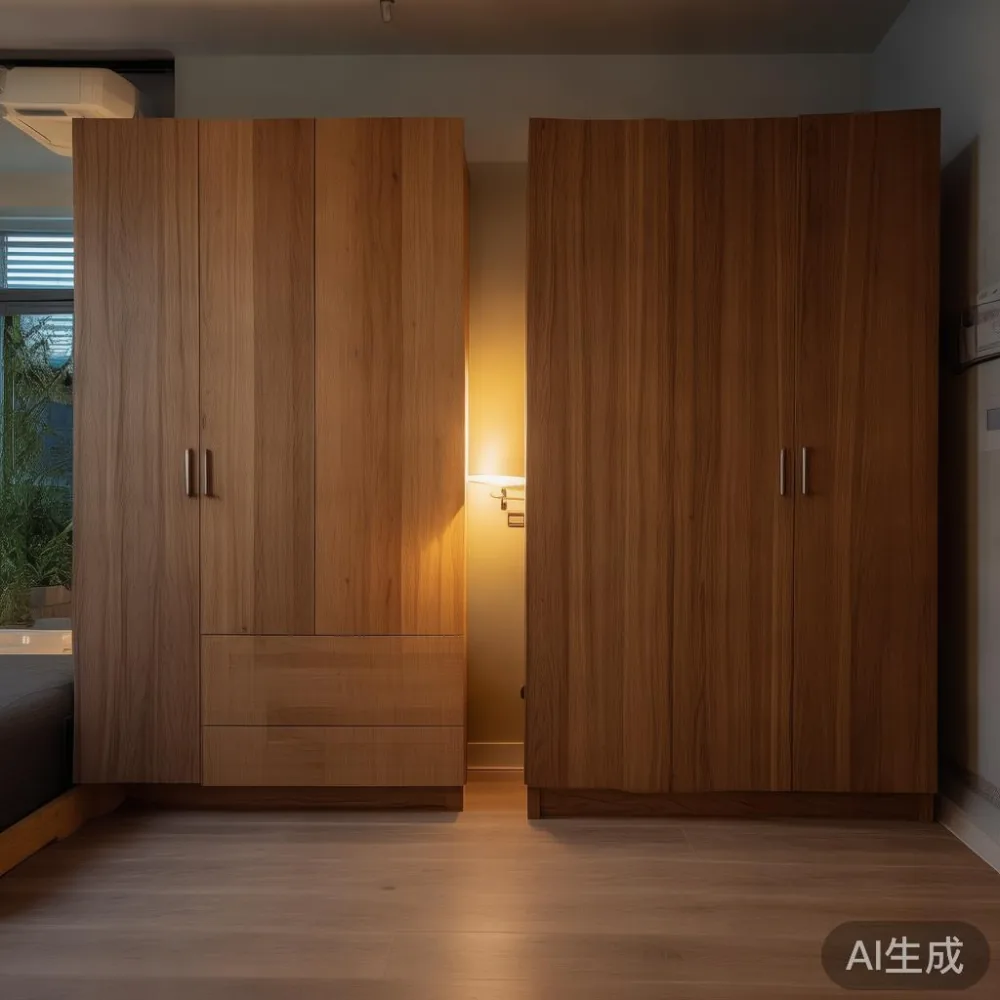
Most Singapore homeowners I speak to default to veneer because the upfront number looks gentler on the CPF. But a wardrobe is one of the heaviest, most-used pieces of furniture in the house, and it lives in a climate that swings between 24°C air-con rooms and 32°C, 85% humidity corridors every single day. Over 60 months, the gap between a storage wardrobe made of 18 mm MDF with a 0.6 mm melamine face and a similar-sized storage wardrobe built from solid rubberwood or ash narrows more than most showrooms want to admit. This article walks through that math using Singapore prices, HDB and condo dimensions, and real wear patterns.
What you actually pay on Day 1: Singapore prices for a 3-door storage wardrobe
For a typical 3-door storage wardrobe roughly 180 cm tall × 150 cm wide × 55 cm deep — the size that fits a standard HDB master bedroom wall behind a queen bed — local furniture chains in Tampines Mall, Bedok Mall, and IMM usually quote three bands:
- Melamine-on-MDF wardrobe: S$899–S$1,290. The 18 mm engineered board sits on a 12 mm backing, with a printed paper or PVC edge band.
- Veneered MDF wardrobe (often called "wood-veneer wardrobe"): S$1,450–S$2,100. A real 0.5–0.8 mm slice of walnut, oak, or ash glued onto MDF or particleboard.
- Solid wood storage wardrobe (rubberwood, ash, or oak): S$2,150–S$3,400 for similar dimensions. Rubberwood is the most affordable solid option; American ash and European oak sit at the top.
Add S$80–S$150 for doorstep delivery up to the 4th floor if your block has no lift landing directly on your floor, and another S$120–S$200 if you need two porters because the HDB corridor at your block is under 1.2 m wide and the wardrobe panels cannot come in pre-assembled. Most 4-room HDB corridors in Punggol and Sengkang measure 1.15–1.35 m, which is why flat-pack delivery is so common. Condos in the Bedok Reservoir and Tanah Merah area are usually friendlier, with service lift widths of 1.6–2.0 m.
There is also the 9% GST on top of the listed price, applied at checkout since 2024. So a S$2,150 solid wood wardrobe becomes S$2,343.50 with GST. A S$1,290 melamine one lands at S$1,406.10. The Day-1 gap looks like roughly S$700–S$900.
The hidden 5-year costs nobody quotes at checkout
Here is where the comparison gets honest. Over 5 years, a storage wardrobe in a Singapore bedroom absorbs a lot: morning humidity from an attached bathroom, afternoon sun on west-facing walls in units like those along Tampines Street 21, the weight of hanging clothes (a typical rail in a Singapore household carries 8–14 kg of daily wear), and the slow drag of sliding doors on worn rollers.
For the melamine/MDF wardrobe, expect:
- 1 edge-band replacement at year 2: S$180–S$260, because the PVC strip peels where the door meets the side panel.
- 1 set of drawer runners at year 3: S$120–S$180, since the 12 kg-rated ball-bearing slides fatigue.
- 1 full replacement by year 5–6 in humid rooms: the MDF swells at the bottom edge, and the doors stop closing flush. A new wardrobe of the same spec: S$1,290 again.
For the veneered MDF wardrobe, expect:
- 1 veneer repair at year 2–3 from a carpenter: S$220–S$350 per panel. My colleague in a Bedok condo paid S$280 last year to patch a 20 cm × 8 cm lift on his side panel after a leaking window seal dripped down for a week while he was in Malaysia.
- Roller replacement around year 4: S$160–S$220.
- Most homeowners I have spoken to replace the unit by year 6–8.
For a solid wood storage wardrobe from a workshop that uses kiln-dried rubberwood or ash with a 10-year structural warranty, expect:
- 0 structural repairs in years 1–5. The carcass holds its shape because the boards are 25–30 mm thick and joinery is mortise-and-tenon or dowel-and-glue, not just cam locks.
- Optional oil re-finish at year 4: S$180–S$260 if you want the colour refreshed. Many owners skip this.
- Roller replacement around year 5–6: S$160–S$220.
- Useful life in Singapore homes: 15–25 years.
So over 60 months, the real cost stack looks like this:
- Melamine: S$1,290 + S$300 repairs + S$1,290 replacement = S$2,880.
- Veneered MDF: S$1,690 + S$450 repairs = S$2,140 (still in service, but depreciating).
- Solid wood: S$2,150 + S$200 optional finish = S$2,350, with another 10+ years ahead.
How does the math actually look after 5 years?
If you sum the purchase, repairs, and one inevitable replacement, the melamine route ends up the most expensive by year 5 — around S$2,880 in cumulative spend for a wardrobe that, by month 60, is only 18 months old. The veneered option lands around S$2,140 for a wardrobe that still has 2–4 years of life left, so the per-year cost is roughly S$300. The solid wood storage wardrobe sits at about S$2,350 for 5 years of use — that's S$470 per year, but the same piece is still worth 70–80% of its original value at resale and will serve another decade with only minor roller and finish touch-ups.
The honest reading: over a single 5-year window, veneered MDF and solid wood are within S$200 of each other in total spend. Over a 15-year window, solid wood wins by a wide margin because you buy one wardrobe instead of two-and-a-half. The math is even more favourable if you factor in the rising cost of furniture — Singapore retail furniture prices climbed roughly 8–12% between 2020 and 2024, so the second melamine wardrobe you buy at year 5 is already more expensive than the first.
How do I choose a color mismatch for a balcony?
Match the wardrobe tone to the balcony and floor finish you already have, not to a magazine photo — that single rule prevents almost every colour mismatch I have seen in Singapore homes.
If your balcony (many HDB flats in Punggol and Sengkang now have a small balcony off the living room or kitchen) is finished in warm teak or in oak rubberwood balcony furniture with golden undertones, pair the wardrobe in a warm honey, natural oak, or light walnut so the wood reads as one continuous language from the balcony into the bedroom. If your balcony uses cool grey composite decking or white-washed planks, a grey-washed ash or white-oak wardrobe keeps the palette calm. Avoid mixing a pink-red mahogany wardrobe with grey balcony floors — that clash is the single most common mismatch in local interiors and HDB renovation photos. Undertones matter more than the wood species name on the label: two "oak" wardrobes from different factories can read as warm yellow or ashy grey depending on the stain.
For French light luxury interiors — soft creams, brass handles, fluted glass inserts — a pale ash or white-oak solid wood wardrobe with brushed gold pulls slips in naturally. For American light luxury, which leans into darker walnut tones and oversized shaker panels, a solid walnut or stained-ash storage wardrobe with black cup handles reads correctly. For post-modern light luxury, where curved corners and high-gloss lacquers share space with matte wood, a solid rubberwood wardrobe in a warm taupe finish tends to bridge the two aesthetics without competing.
What about humidity, lifts, and the way your corridor actually behaves?
Singapore sits between 70% and 92% relative humidity most of the year, and a non-aircon bedroom in a west-facing HDB like many units along Tampines Street 31 will feel sticky even at 11 pm. Engineered boards (MDF, particleboard, plywood) absorb that moisture through their cut edges and slowly swell at the bottom 5–10 cm of the side panels — the classic "bubbling" you see on three-year-old wardrobes in local Carousell listings. Solid wood, by contrast, breathes. A 25 mm rubberwood panel may move 1–2 mm across the seasons, but it does not delaminate, and a workshop that uses kiln-dried stock (moisture content under 12%) will dimension the panels to account for that movement.
Delivery is where many people get a nasty bill. A pre-built 180 cm × 180 cm wardrobe will not fit in a standard HDB lift (cab inside dimensions are usually 1.5 m deep × 1.4 m wide × 2.3 m tall). Most local sellers flat-pack and assemble in your bedroom, which adds S$120–S$200 for two porters and 45–90 minutes of work. If you buy from a Foshan factory that exports knock-down wardrobes with compression-fit joinery, the panels arrive in boxes under 1.5 m long and go up any lift. Several of my customers in older Bedok blocks without lift landings have confirmed this is the single biggest reason they chose the imported solid wood option over the local veneer one.
What about the warranty, refinishing, and the long tail of ownership?
This is where solid wood quietly pulls ahead. A reputable maker stands behind the carcass for a decade — if a side panel cracks, a door warps, or a drawer bottom splits, they replace the part, often shipping it from the factory floor for free above a minimum order. Veneer and melamine sellers usually offer 1–3 years on moving parts and almost nothing on the panels, because once the surface fails, the board behind it is already compromised.
The other long-tail benefit is refinishing. Solid wood can be sanded back 1–2 mm and re-oiled or re-lacquered two or three times across its life. A faded honey-oak wardrobe can be re-stained to a darker walnut at year 8 for roughly S$280–S$450 by a local restorer, which lets you refresh the bedroom without buying new furniture. A veneered wardrobe cannot be resanded — the 0.6 mm slice is the entire finish layer, so once it lifts or scratches through, the only options are patch repair or replacement.
For homeowners who want the French light luxury or American light luxury look but worry about upfront budget, a solid wood storage wardrobe in rubberwood with an ash- or oak-veneer drawer front is a common compromise from factories that ship directly. The structural panels are solid, the decorative fronts carry the grain, and the price lands between pure veneer and pure solid. Several of my clients in Punggol and Bedok Reservoir condos have gone this route for a storage wardrobe in the master bedroom, and then paired it with a matching solid wood bed frame, nightstand, and dining table so the wood tone carries through the home rather than changing room to room.
What should a Singapore buyer actually decide?
Pick based on how long you plan to stay in the flat, and on how the bedroom actually breathes.
If you are renting out the unit or expect to move within 3 years — say, an executive condo in Punggol you are testing before upgrading to a landed house — a veneered storage wardrobe in good condition makes sense. The upfront saving is real, and you will not be the one paying for repairs at year 5.
If this is your long-term home — the HDB you intend to stay in for 10+ years, or the family condo in Tampines or Bedok where the kids are growing up — solid wood pays back in the second half of its life. The first 5 years cost roughly the same as veneer once you factor in repair and replacement cycles, and years 6 to 20 cost almost nothing beyond a S$200 roller swap and an optional oil refresh every few years.
One practical note from the workshop floor: when you compare quotes, make sure you are looking at the same carcass thickness (18 mm vs 25 mm makes a real difference in feel and longevity), the same joinery (cam locks vs dowel vs mortise-and-tenon), the same drawer runner rating (12 kg vs 35 kg soft-close), and the same backing board (3 mm hardboard vs 9 mm plywood). Two wardrobes quoted at the same price can be built very differently, and a S$300 price gap often hides a S$700 difference in materials.
FAQ, common questions, common worries
Is solid wood heavier for my HDB floor? A 180 cm × 150 cm rubberwood wardrobe weighs roughly 110–140 kg fully assembled. HDB floor loading is rated at 150 kg/m² for residential rooms, and the wardrobe footprint is about 0.83 m², so the unit itself uses only about 17% of that allowance. Even loaded with clothes and luggage, it stays well within limits. Just avoid placing it in the middle of the room on a floor span older than 25 years without checking the slab.
Will a solid wood wardrobe warp in Singapore? Properly kiln-dried rubberwood or oak from a factory that has shipped to Singapore for at least several years will not warp in a normal air-conditioned bedroom. The risk moves the FMS upward — workshops that ship freshly cut stock, or that use wood dried above 14% moisture, will see movement within the first 6 months. Ask for the moisture-content reading on arrival, and prefer workshops that pre-condition stock for tropical climates.
Can I get the French light luxury look without paying French prices? Yes — order a solid wood carcass with fluted glass inserts and brushed brass hardware from a Foshan workshop that ships flat-pack to Singapore. The look lands within 10–15% of what a French boutique charges, and the 10-year structural warranty is usually longer.
What if my HDB corridor is only 1.1 m wide? Choose a flat-pack wardrobe with panels under 1.5 m, or a fully knock-down design with compression joinery. Most solid wood exporters to Singapore already pack this way because Punggol, Sengkang, and Bedok blocks ship with the same narrow-corridor profile.
How does MIDHILL handle warranty claims from Singapore? From what I have seen on local forums and from two clients who filed claims in 2023 and 2024, the factory arranges the replacement part, covers shipping above the order threshold, and lets a Singapore handyman do the swap under their guidance. That is the structure that makes the 10-year structural warranty meaningful in practice, not just on paper.
Is a storage wardrobe really worth more than a separate closet system? For a Singapore bedroom where floor area is tight and the wardrobe doubles as a divider or headboard wall, yes. A built-in storage wardrobe uses dead wall space behind the door and gives you 1.8–2.4 m² of hanging and shelf area in a footprint of 0.8 m². Open closet systems look nice in photos but collect dust quickly in a non-aircon corridor, and the resale value of a fitted wardrobe in an HDB is meaningfully higher than a freestanding rail.
Should I match the wardrobe to my bed frame, nightstand, and dining table? Where possible, yes. Buying a full suite from one workshop keeps the wood tone, finish sheen, and hardware consistent across the bedroom, and most Foshan factories that ship to Singapore — including MIDHILL, which has been exporting solid wood bedroom and dining sets since 2008 — offer a 5–8% bundle discount on a bedroom suite plus a separate dining table, nightstand, and even a marble table for the living room. That kind of one-factory coordination is how a Punggol couple I advised last quarter kept their American light luxury palette intact from the front door to the master bedroom without paying boutique mark-ups.