Warm Minimal Interiors in Singapore HDBs: Matching Solid Wood Furniture Without the Cold Look
I still remember walking into a four-room flat in Tampines last month. The owner had just painted everything in a chalky off-white, installed slim black track lights, and lined the living room with a low-profile storage wardrobe that ran almost wall-to-wall. The bones were right, but the room felt a little surgical. We added one piece at a time — a 200 cm solid wood sofa in white oak, a small marble table by the window, and two bedside cabinets in walnut. Within an hour the same flat read warm, calm, and quietly expensive. That is the starting point for everything in this guide: how to layer a warm minimal interior in a typical Singapore HDB or condo without losing the clean geometry the style depends on.
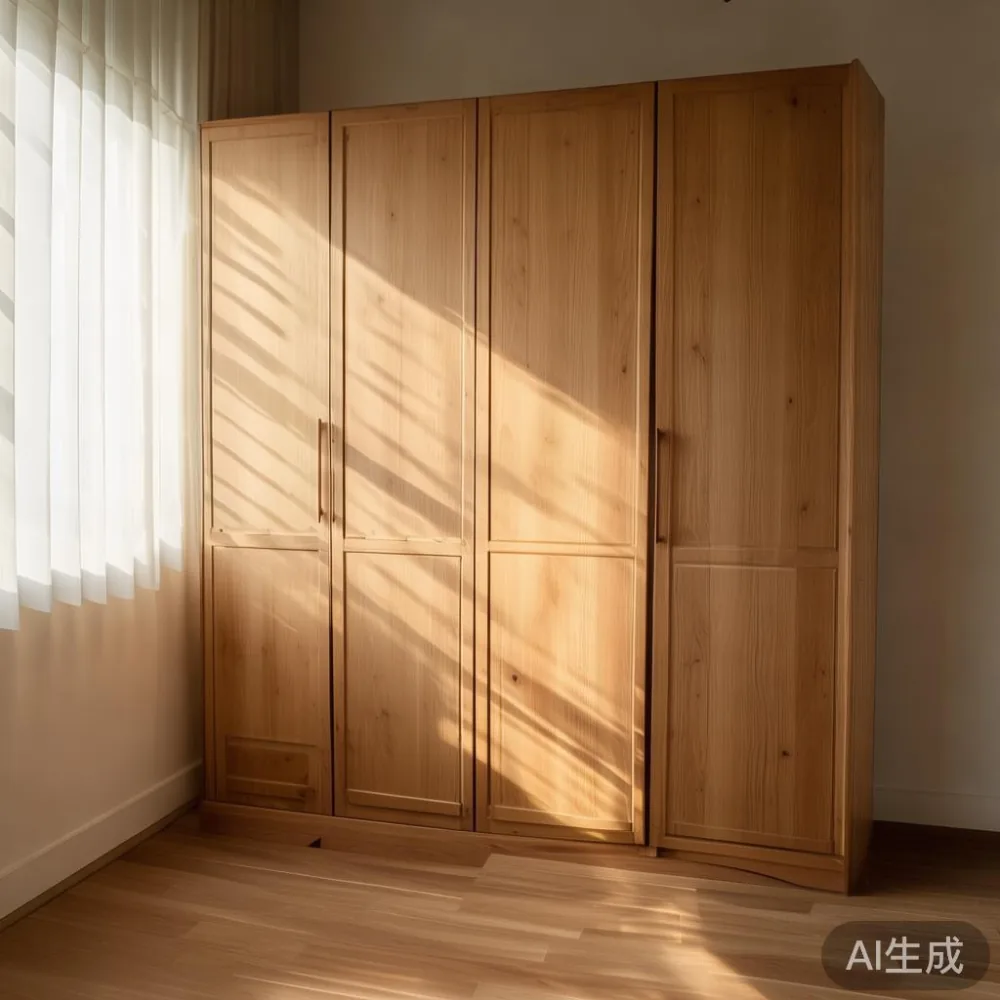
What "warm minimal" actually means in a 90 sqm HDB
Warm minimalism is not Scandinavian minimalism with a yellow bulb. The Scandinavian version leans pale grey, whitewashed pine, and high contrast. Warm minimalism keeps the discipline — flat fronts, tight reveals, nothing on the counter that does not earn its place — but it swaps cool whites for cream, off-white, oat, and the mid-tone browns of white oak, natural ash, and light walnut. The colour temperature sits around 2700 K to 3000 K on the LED side, and the wood tones sit between honey and caramel, not the grey-washed Scandinavian range.
In a Singapore context this matters because most HDBs in Tampines, Bedok, and Punggol already get strong daylight from side windows. If you push everything too cool, the room reads clinical by 11 am. If you push everything too warm, the room reads dim by 7 pm. The fix is a 60/30/10 split: 60% neutral surface (walls, ceiling, large cabinetry), 30% warm wood (solid wood sofa frame, dining table top, bed frame headboard), 10% accent (a single piece of marble, a linen curtain, one brass detail). A 240 cm storage wardrobe in cream oak becomes part of that 60% backdrop rather than a competing block.
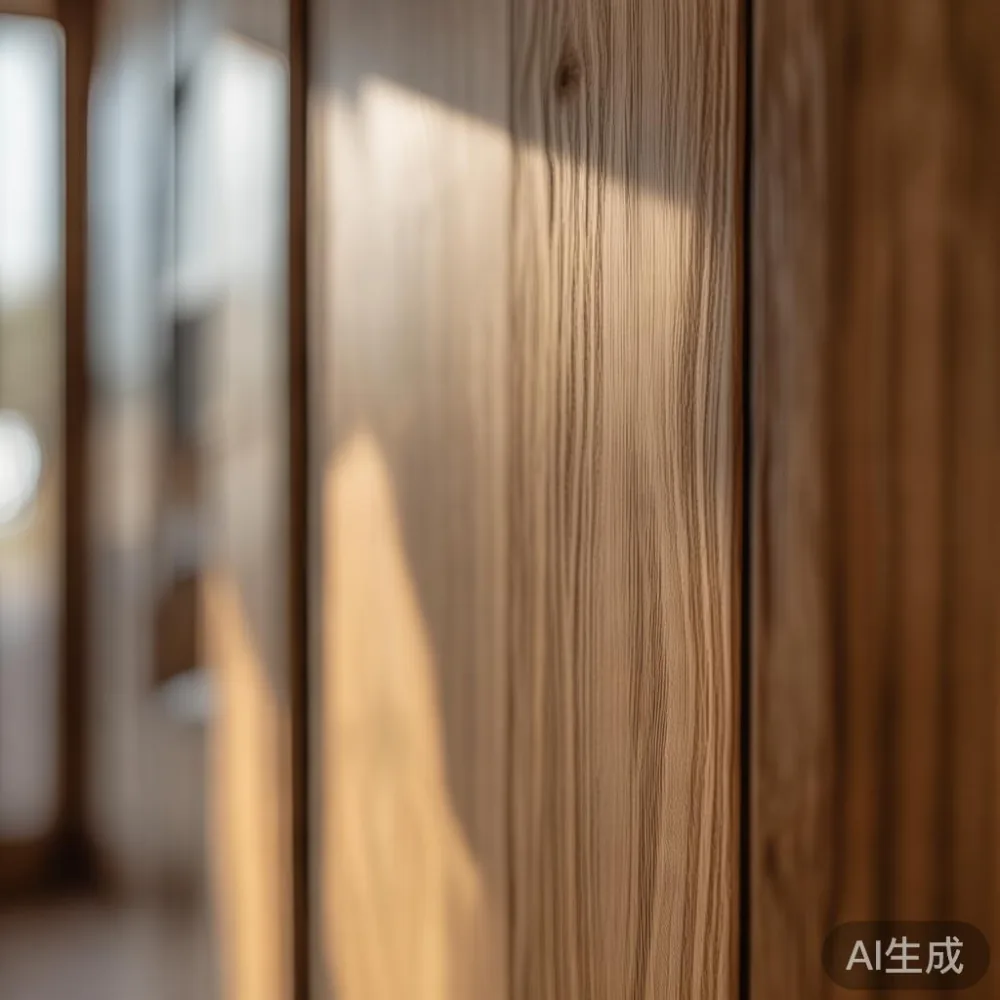
Where does the storage wardrobe sit in a warm minimal layout?
The storage wardrobe is usually the largest single piece in the bedroom, so it sets the wood tone for the rest of the room. If you start with a grey-laminate wardrobe and then try to bring in a honey oak bed frame, the eye reads them as two unrelated objects. The simpler path is to let the wardrobe carry the warm tone and let everything else support it. A floor-to-ceiling storage wardrobe in cream oak, white oak veneer, or light walnut gives you 2.4 m of continuous grain that reads as one calm wall. Doors should sit flush, handles should be a 12 cm integrated finger pull or a 6 cm brushed brass bar, and the plinth should be recessed 3 cm so the unit appears to float.
For HDB bedrooms in the 10 to 12 sqm range, a 200 cm to 240 cm three-door storage wardrobe is the usual fit. Leave a 90 cm walkway at the front, which is the minimum for a comfortable dressing zone without bumping the bed. If the wardrobe faces the door, consider a 60 cm tall base section in rattan or cane to break up the slab — it adds warmth and is a quiet nod to French light luxury interiors where cane panels are common on bedroom cabinets. If the ceiling height is the standard 2.8 m, keep a 15 cm shadow gap above the wardrobe rather than forcing a built-in look; the floating effect feels lighter and is easier to dismantle if you move.
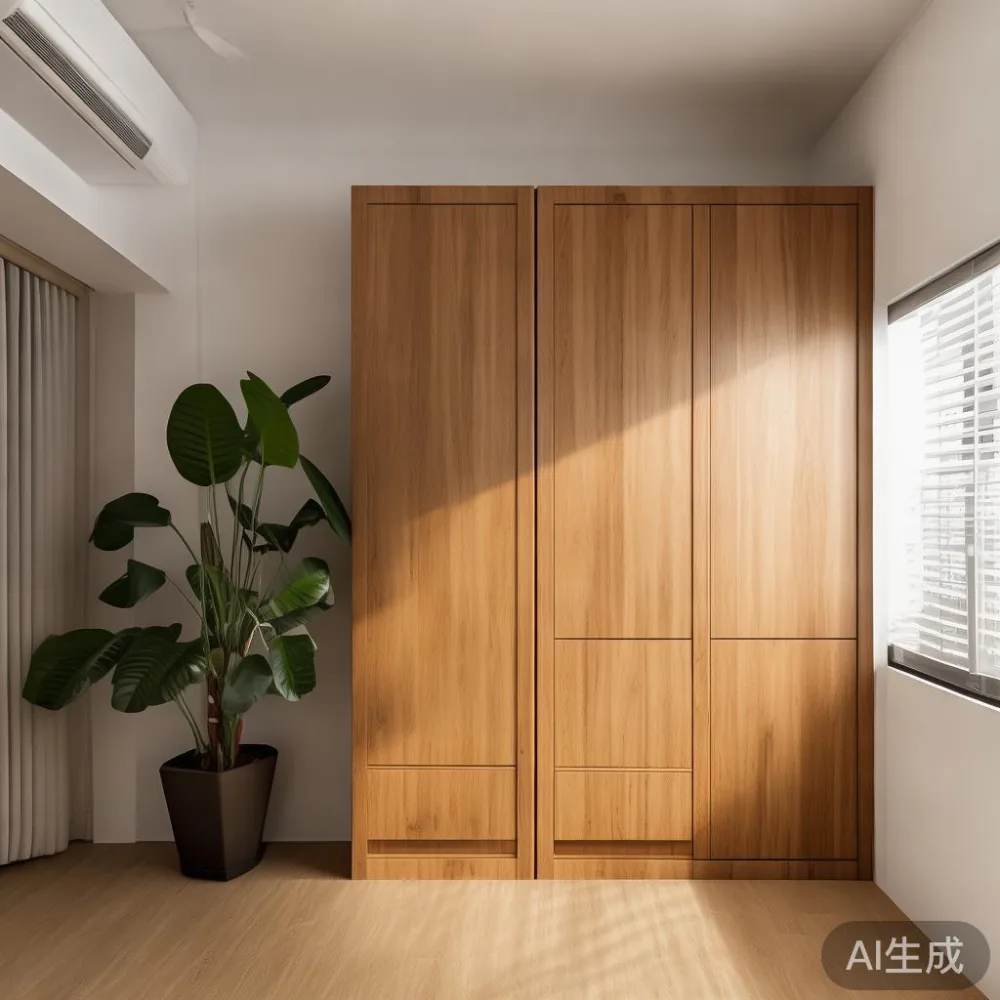
One thing I learned from my colleague who fits out BTO flats in Punggol: lift openings on newer HDB blocks are about 1.2 m wide and 2.1 m tall, and the service lift is usually 1.5 m by 1.8 m. A flat-pack storage wardrobe in 4 cartons under 2.1 m is the only realistic option for self-collection; everything larger needs the cargo lift, which adds about SGD 60 to SGD 120 to the delivery fee and a one-week booking window.
Should I choose solid wood or engineered wood for the warm tones?
Honest answer: it depends on budget and on which piece. Solid wood is the right call for items you touch every day — a bed frame you lean against, a dining table you eat on, a nightstand you reach for at 2 am. Engineered wood with a thick wood-look laminate is the right call for large vertical panels where structural solidity matters more than the feel of the grain. A 240 cm storage wardrobe in engineered board with a 0.8 mm wood laminate is stable in Singapore humidity (which sits at 70% to 85% for most of the year) and costs roughly 40% less than the same unit in solid timber. A solid wood sofa frame, on the other hand, is worth the premium because the arms and base take constant load.
For a four-room HDB, a reasonable budget split looks like this:
- Storage wardrobe (240 cm, three-door, cream oak laminate on engineered board): SGD 1,800 to SGD 2,800.
- Solid wood bed frame in white oak, queen size (152 cm x 188 cm): SGD 1,200 to SGD 2,200.
- Solid wood dining table in ash, 160 cm x 80 cm, seats four to six: SGD 900 to SGD 1,600.
- Solid wood sofa, three-seater, 210 cm to 220 cm: SGD 1,400 to SGD 2,800.
- Nightstand pair in walnut, 50 cm x 40 cm x 55 cm: SGD 350 to SGD 600 each.
- Marble table (side or coffee), 90 cm diameter, Carrara or travertine-look top: SGD 600 to SGD 1,200.
Add 9% GST on top of the furniture total. For a full warm-minimal bedroom and living room package, you are usually looking at SGD 7,500 to SGD 11,000 before GST, which lands inside the typical renovation furniture budget for a new BTO owner in their early thirties.
How do I keep the look warm without it feeling cluttered?
The trick is to limit the number of wood tones to two, and to keep the grain direction consistent across the largest pieces. If the storage wardrobe runs vertical grain, let the bed frame headboard run vertical too; if the dining table is horizontal plank, pair it with horizontal plank open shelving. Mixed directions fight each other in a small HDB bedroom because there is no distance to soften the join.
Lighting is the second half of the warmth. A single 4000 K downlight will undo everything the wood is doing. Aim for three layers: ambient at 2700 K to 3000 K (a flat LED panel or a fabric pendant, around 2,400 lumens for a 12 sqm bedroom), task at the wardrobe interior (a 12 V LED strip on a warm 3000 K with a PIR sensor, so the inside of the storage wardrobe glows when you open it), and accent at 2200 K to 2400 K (a single bedside wall light or a small picture light above the dresser). The accent layer is what gives the room the candle-warm after-dark feel that defines warm minimal.
Textiles do the rest. Linen curtains in oat, a wool rug in tobacco or rust (around 200 cm x 300 cm for a queen bed, anchored so 30 cm of floor shows on each side), and one or two cushions in a heavier weave. Keep patterns to a single accent — a check, a thin stripe, or a quiet botanical — and never mix two patterns on the same surface. A 220 cm solid wood sofa with three linen cushions and one patterned cushion is enough; adding a throw blanket in a third colour is the moment the room tips from warm minimal to warm maximal.
What wood tones pair with what wall colour?
Three pairings cover most warm-minimal HDB projects I have seen over the past two years.
1. Cream walls (Dulux 30YY 83/026 or Jotun 14580 Elegant) with white oak. This is the safest pairing and works with almost any existing floor tile, including the common beige porcelain that ships with BTO flats. White oak has a pinkish undertone that softens the cream rather than fighting it.
2. Greige walls (Dulux 30YY 57/060 or Nippon ND265) with light walnut. Slightly more contrast, slightly more grown-up. A 240 cm storage wardrobe in walnut laminate anchors the room without going dark, and a marble table in travertine-look stone gives you the second texture.
3. Soft clay walls (Dulux 50YR 39/150 or Jotajoco Clay) with ash or natural oak. This is the warmest option and reads closer to American light luxury — that wider, residential, lived-in feel. Keep the ceiling pure white (NN9762 or similar) or the room will feel heavy, especially in a 10 sqm bedroom.
Whatever pairing you pick, sample it on an A3 board and live with it for two days before committing. Singapore light shifts fast — a colour that looks perfect at noon can read pink at 7 pm. A two-day test costs you nothing and saves a SGD 600 repaint.
Are accent chairs and dressing tables worth the spend in a small flat?
In a 90 sqm condo, yes, but only if they earn their place. A European light luxury accent chair placed at the end of the bed or in a reading corner does three things: it breaks up the straight lines of the storage wardrobe, it adds a curve where everything else is rectangular, and it gives you a place to throw tomorrow's clothes without piling them on a chair that should not be touched. Look for a 65 cm to 70 cm seat height, a 55 cm seat depth, and arms that sit low enough to slide under a standard 75 cm table. Velvet in rust, sage, or deep ochre works well against oak; boucle in cream works well against walnut. Budget SGD 450 to SGD 900 for a solid wood frame chair from a regional maker.
The dressing table question is similar. A European light luxury dressing table with a single drawer, a slim oval mirror, and tapered legs in oak or ash gives you a real morning routine instead of leaning into a bathroom mirror. For a 12 sqm HDB bedroom, a 100 cm x 45 cm dressing table fits against the side wall opposite the storage wardrobe, with a 50 cm to 60 cm stool tucked under. Expect SGD 700 to SGD 1,400 for a solid wood version with a soft-close drawer. The stool can be the accent chair — a velvet chair in the dressing zone and a linen bench at the bed foot are a common swap in small layouts.
If you are weighing a European sofa vs French provincial sofa, the difference matters more than people think. A French provincial sofa is deeper (95 cm to 105 cm seat depth), higher-backed, and usually skirted or has carved wooden legs. It reads romantic and traditional, and it needs at least 3 m of clear wall to breathe. A European sofa in the modern sense is 85 cm to 90 cm deep, lower-backed, on slim 15 cm legs, and works in 2.6 m walls — which is most HDB living rooms. If you want French light luxury in a condo, get the curves from the accent chair and the marble table instead, and keep the main sofa European.
Is a Mid-century modern bed worth it for a warm minimal HDB bedroom?
This is a fair question and I get asked it every week. A Mid-century modern bed — tapered legs, low platform, slatted headboard in walnut or teak — is worth it if you want the bed to be the visual anchor of the room. In a 10 to 12 sqm HDB bedroom with a floor-to-ceiling storage wardrobe already taking the back wall, the bed is the only other large object. A 152 cm x 188 cm queen bed in solid walnut with a 90 cm headboard and 18 cm legs becomes the warm focal point that balances the wardrobe. Solid walnut frames in this style usually run SGD 1,400 to SGD 2,400. Engineered alternatives in walnut veneer start around SGD 700.
The honest test is to ask whether you will read the room in five years. If yes, the solid wood version pays back through longevity and through a lifetime refinishing option that some regional makers (including the team behind midhill.co) offer for their solid wood beds and wardrobes. A sand-and-re-oil every eight to ten years keeps a walnut frame looking new, which is harder to do with a veneer. If the answer is no — if you treat the bedroom as a short-term setup — engineered board at SGD 700 is the rational call.
Pairing wise, the Mid-century bed sits well with an Italian light luxury nightstand: a 50 cm x 40 cm x 55 cm two-drawer cabinet in oak or ash, slim 8 mm handles, 20 cm legs. Italian light luxury nightstand designs tend toward restrained geometry, which is what warm minimal needs. Two matching nightstands, one on each side, finish the symmetry and give both partners a real surface — a phone, a glass of water, a book — without reaching across the bed.
How should I plan delivery and installation for a full warm-minimal package?
Singapore delivery runs on a tight corridor. Standard HDB corridor width is about 1.2 m to 1.5 m, and front doors are usually 0.9 m wide. A flat-pack storage wardrobe in four cartons under 2.1 m long and under 35 kg each is the upper limit for easy self-collection. Anything heavier or longer needs a two-man team and a service lift booking, which adds SGD 80 to SGD 150 per trip and a 5 to 10 working day lead time.
For a typical four-room package (storage wardrobe, bed frame, dining table, solid wood sofa, two nightstands, marble table), expect:
- Production lead time: 25 to 40 working days for made-to-order solid wood pieces.
- Delivery window: 5 to 7 working days within mainland Singapore after production.
- Two-man carry-in and assembly: SGD 120 to SGD 280 for the full set.
- Free shipping threshold: most regional makers, including the Foshan-based workshop MIDHILL has shipped through since 2008, offer free delivery above US$350 (about SGD 480) on flat-pack items.
Add a 14-day return window and a 10-year structural warranty on solid wood frames, and the financial risk of buying solid wood online drops sharply. Read the warranty wording carefully — structural warranty covers joints and frames, not finish wear — and keep one square metre of the original laminate or fabric sample in case of a future colour match.
What does a finished warm-minimal bedroom actually look like?
Picture a 12 sqm HDB bedroom in Punggol. Walls in Jotun 14580 Elegant, ceiling in pure white, floor in the original beige porcelain. Against the back wall, a 240 cm three-door storage wardrobe in cream oak laminate, 240 cm tall, with a 15 cm shadow gap above and a 3 cm recessed plinth below. Opposite, a 152 cm x 188 cm queen bed in solid white oak with a 90 cm slatted headboard, dressed in oat linen. Two Italian light luxury nightstands in ash flank the bed. A 100 cm European light luxury dressing table sits on the side wall with a slim oval mirror and a velvet stool in rust. A 90 cm marble table by the window holds a single ceramic lamp. Three warm LED layers — 2700 K ambient, 3000 K wardrobe interior, 2200 K wall sconce — finish the room. Total furniture spend: about SGD 8,200 before GST.
That is what warm minimal looks like in 2026 Singapore: cream walls, two wood tones, one stone accent, three layers of warm light, and a storage wardrobe that quietly does the heavy lifting in the background. No clutter, no cold grey, no shouting. Just a calm room that you actually want to come home to.
FAQ: what should I measure before I order?
- Door width and corridor width (in cm). Anything over 90 cm door and 120 cm corridor is fine for flat-pack.
- Ceiling height and any air-con ledge depth. Standard HDB ceiling is 2.8 m; a 2.4 m wardrobe with a 15 cm shadow gap fits cleanly.
- Lift opening width and service lift booking window for non-flat-pack items.
- Floor level difference between rooms, in case you want continuous wood grain across the wardrobe and a side cabinet.
- Switch and socket positions, so the wardrobe does not cover a spur point you still need.
How to choose Japandi sofa pieces that fit warm minimal without going cold?
Japandi sofas are the easy trap to fall into here. Many Japandi sofas on the Singapore market lean pale grey with black steel legs, which is exactly the cold note you are trying to avoid. The fix is to treat Japandi as the geometry and warm minimal as the palette: keep the low 38 cm seat height, the 85 cm depth, the slim 12 cm to 15 cm wooden legs, and the plain seat cushion. Then change the fabric to a boucle in oat, a linen in tobacco, or a textured weave in cream. A 210 cm to 220 cm Japandi-shape sofa in boucle with oak legs costs around SGD 1,800 to SGD 3,000 and pairs naturally with a 90 cm marble table and a cream oak storage wardrobe across the room. The rule when you research how to choose Japandi sofa pieces is simple: if the floor sample reads Scandinavian grey, walk past. If it reads warm cream or honey, you have the right one.
Final checklist before you tap "order"
Before you commit on a full warm-minimal package, run through these five checks. One: every wood tone in the room is one of two colours (white oak + walnut, or ash + light walnut). Two: the storage wardrobe grain direction matches the bed headboard grain direction. Three: lighting is on a three-layer plan, not a single downlight. Four: at least one piece of marble or stone breaks up the wood. Five: the delivery plan covers corridor width, lift size, and a 14-day return window in case the cream reads more yellow at home than on screen. If all five pass, the room will hold together for the next ten years with nothing more than a linen curtain change and a furniture oil every now and then.